


Old Time Plants and Native Plants Combine for a Garden of Beauty
Updated: Jul 30
Plants with history & plants with purpose.

Did you ever take a Sunday drive as a kid with your family? Maybe a short excursion in town or a longer one out to the countryside? Kathleen Luisa of Arlington, Virginia did every Sunday with her mother and grandparents and it eventually led her to a garden filled with all sorts of native plants. Kathleen, a social worker by trade, is a Master Naturalist, kayaker, geology groupy and avid gardener. Living now in her childhood home, she has evolved the garden she grew up in, to a delightful mix of native trees, shrubs, perennials and groundcovers along with favorite annuals, tomatoes and peppers and a number of legacy plants. It all combines to create a home nestled in the center of an 1/8th of an acre lot brimming with life and beauty.
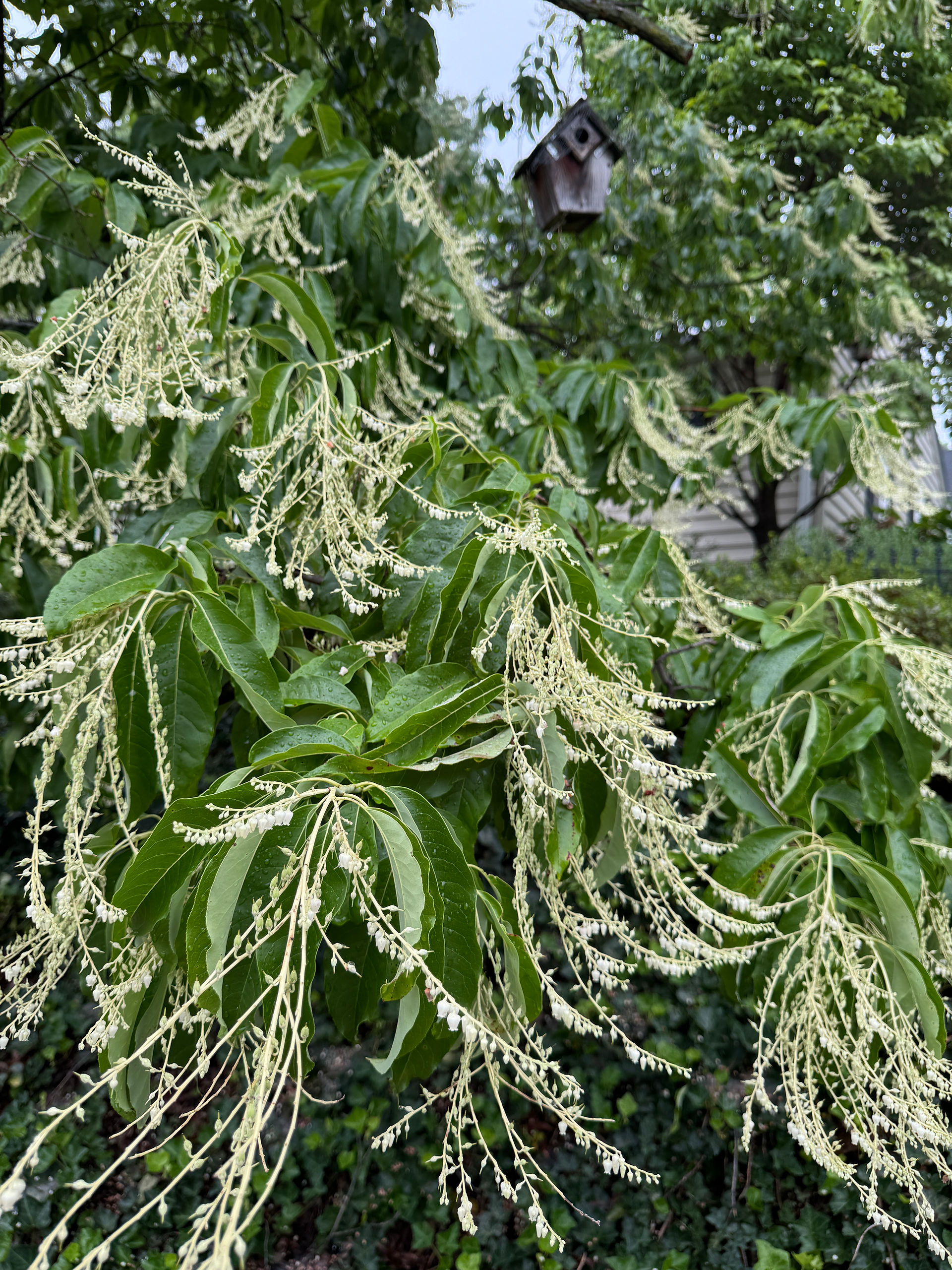
sourwood blooming 
mature sourwood tree
Kathleen says beauty was the point of those Sunday drives. The destinations were not always parks or other natural locales but anything exhibiting some measure of beauty. It could be some simple flowers, a building or a view near or far and Kathleen says the drive always included a fun lunch stop which encouraged her and her family to really enjoy those sights, large or small. The garden she grew up in was the same - filled with plants of beauty.

Azaleas, a hydrangea (Hydrangea paniculata) planted by her mother over fifty years ago, now pruned as a small tree, several dogwoods and a stunning sourwood tree (Oxydendrum arboreum) are a few of the legacy plants that remain. Kathleen, once she embarked on her native plant garden, chose to keep many of her favorite plants for beauty and, at the same time, she has deftly mixed in an incredible range of natives. There is a lot of history in this garden. The plant with the greatest family history is a sedum, now over 100 hundred years old, that grew in her great grandmother's garden.

wild petunia 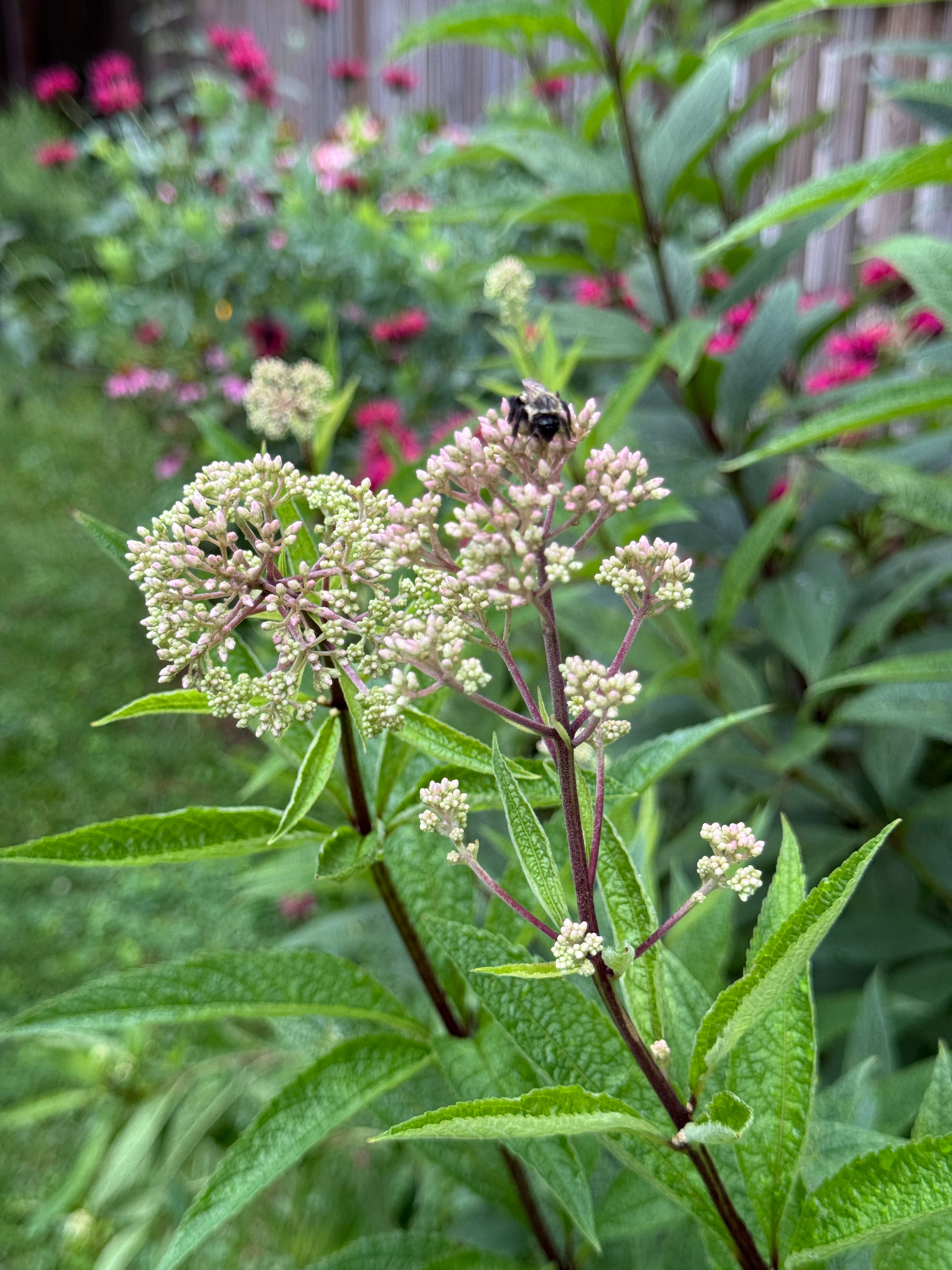
joe pye weed 
eastern bee balm
This native plant garden began in earnest when Kathleen read an announcement for a Master Naturalist training just over 18 years ago. Already interested in bees, the training sounded intriguing. That training led Kathleen to learn more about insects and that took her to becoming a beekeeper and, of course, native plants! Once the garden became hers to shape, Kathleen knew she wanted to add natives and make careful choices about which plants from her childhood garden she would keep and which she would forego.

Native deciduous azaleas (Rhododendron periclymenoides, Rhododendron austrinum, Rhododendron arborescens) now mix with older evergreen azaleas (Rhododenron indicum). Kathleen replaced the introduced hollies with inkberries (Ilex glabra) at the front of the house. These inkberries were small when planted five or so years ago and are now thriving.
summersweet 'Sixteen Candles' 
wild strawberry
Kathleen's Mom had terraces built on either side of the front steps to make the steep front slope a bit more gardener friendly. Kathleen planted wild strawberry (Fragaria virginiana) in this lower bed, the perfect place for this evergreen groundcover that can be a spreader. It is nicely contained on all sides and low maintenance. Another inspired choice was planting these summersweet 'Sixteen Candles' (Clethra alnifolia 'Sixteen Candles') shrubs in the upper terrace. Their placement at the front edge of the bed encourages the shorter statured summersweet to drape over the ledge. That's beautiful.

wild ginger 
wild violets
Along the shadier side of the home, Kathleen planted those native azaleas along the side of the house. She is a big believer in the "let the plants tell you where they want to be" approach so she is experimenting with some groundcovers for shade along this side of the house. Wild violets (Viola sororia) are doing very well. A bit farther along the path, Kathleen planted a handful of wild ginger (Asarum canadense). They have really taken off creating a robust drift. Kathleen says they abruptly stopped spreading once they reached a spot just beyond the deeper shade they were thriving in.

oakleaf hydrangea and Pennsylvania sedge 
Pennsylvania sedge
The exact same thing happened on the other side of the house. Pennsylvania sedge (Carex pensylvanica) had been growing nicely along the fence line until the house next door was rebuilt changing the light conditions. A portion of the sedges started to flag due to more light. Kathleen listened and replaced the sedges in the sunnier areas with a combination of asters and goldenrods for autumn color.
Goldenrods (Solidago) and ironweed 'Iron Butterfly' (Vernonia lettermannii 'Iron Butterfly'), a smaller cultivar, are planted throughout the garden to create fall color. Kathleen planted blue-stemmed goldenrod (Solidago caesia) for shade and 'Fireworks' goldenrod (Solidago rugosa 'Fireworks') for sun. Likewise, Kathleen has lots of asters: smooth aster (Symphyotrichum laeve), aromatic aster (Symphyotrichum oblongifolium), blue wood aster (Symphyotrichum cordifolium) and white wood aster (Eurybia divaricata). While Kathleen laments the amount of green created by those plants right now, she says she relishes the color and habitat they create long into fall. She has noted a dramatic increase in the variety of pollinators and birds the asters have brought into the garden.
That prompted us to talk about the challenges of always having something blooming at all times. Kathleen says she takes a relaxed approach. She has lots blooming in summer and fall. Spring, not so much, she says. She did start growing Virginia bluebells (Mertensia virginica) a year ago which she mixed in with her large swath of native anemone (Anenome virginiana) and is looking forward to getting those going.

This fence line which gets a bit more sun is planted with a mix of culver's root (Veronicastrum virginicum), blue verbena (Verbena hastata) and cutleaf coneflower 'Herbstonne' (Rudbeckia laciniata "Herbstonne') which is slightly shorter than the straight species. She planted the straight species of cutleaf coneflower (Rudbeckia laciniata) that easily grows to 8' tall toward the front of the house where the height is an asset. Kathleen prefers to use straight species of any plant wherever possible due to their preference by pollinators as host and nectar plants.

Kathleen described the pond she had installed three years ago as the best decision she has ever made for the garden. And this is where her love of rocks and geology come in. Kathleen had stockpiled various rocks and stones she either found or were given to her over the years, not sure how she would eventually use them. When she hired a pond builder to install the pond, he proposed using grey stones. Kathleen assured him she had all the stones he would need! The pond builder expressed skepticism but agreed. Once he finished the pond, he declared it one of the funnest projects he had worked on because the variety of the rocks Kathleen collected created a wonderful challenge. The pond builder and Kathleen also settled on shorter drops for the two falls leading into the pond. This decision created a gentler more soothing sound of water and seems to suit the fairly flat back garden area.

raspberry wine bee balm 
blue verbena
The pond is surrounded by swamp milkweed (Asclepias incarnata), pink tickseed (Coreopsis rosea), blue verbena and 'Raspberry Wine' bee balm (Monarda "Raspberry Wine'). Kathleen has dotted the bee balm around the back garden. Kathleen finds this cultivar of bee balm longer lasting than red bee balm (Monarda didyma 'Jacob Kline') and less susceptible to mildew. Whether paired with swamp milkweed or adding a pop of color to the large bed of mountain mint (Pycnanthemum muticum), these flowers bring whimsy to the garden.

skullcap, bee balm and monarch's delight 
swamp milkweed
Another fun combination of color is created by this mix of monarch's delight (Asclepias tuberosa), downy skullcap (Scutellaria incana) and bee balm. Kathleen recently added swamp milkweed next to some of the 'Raspberry Wine' bee balm. As the swamp milkweed budded up, Kathleen looked forward to seeing what the combination looked like. When she inadvertently broke a stem of swamp milkweed before it flowered, she did some quick research and learned you can create a splint for a partially broken stem. I kid you not. The splint is created with two plant tags, some painters tape, a stake and plastic ribbon. And that very stem is now flowering beautifully. Who knew?!
As you might expect from a Master Naturalist, Kathleen follows many best practices for supporting wildlife. She leaves fallen leaves on the ground and perennials standing in fall to provide seeds to birds over winter and nesting cavities for overwintering insects. She focuses on plants that produce seeds and berries or serve as host plants for certain insects.

honeysuckle vine 
raspberry wine bee balm 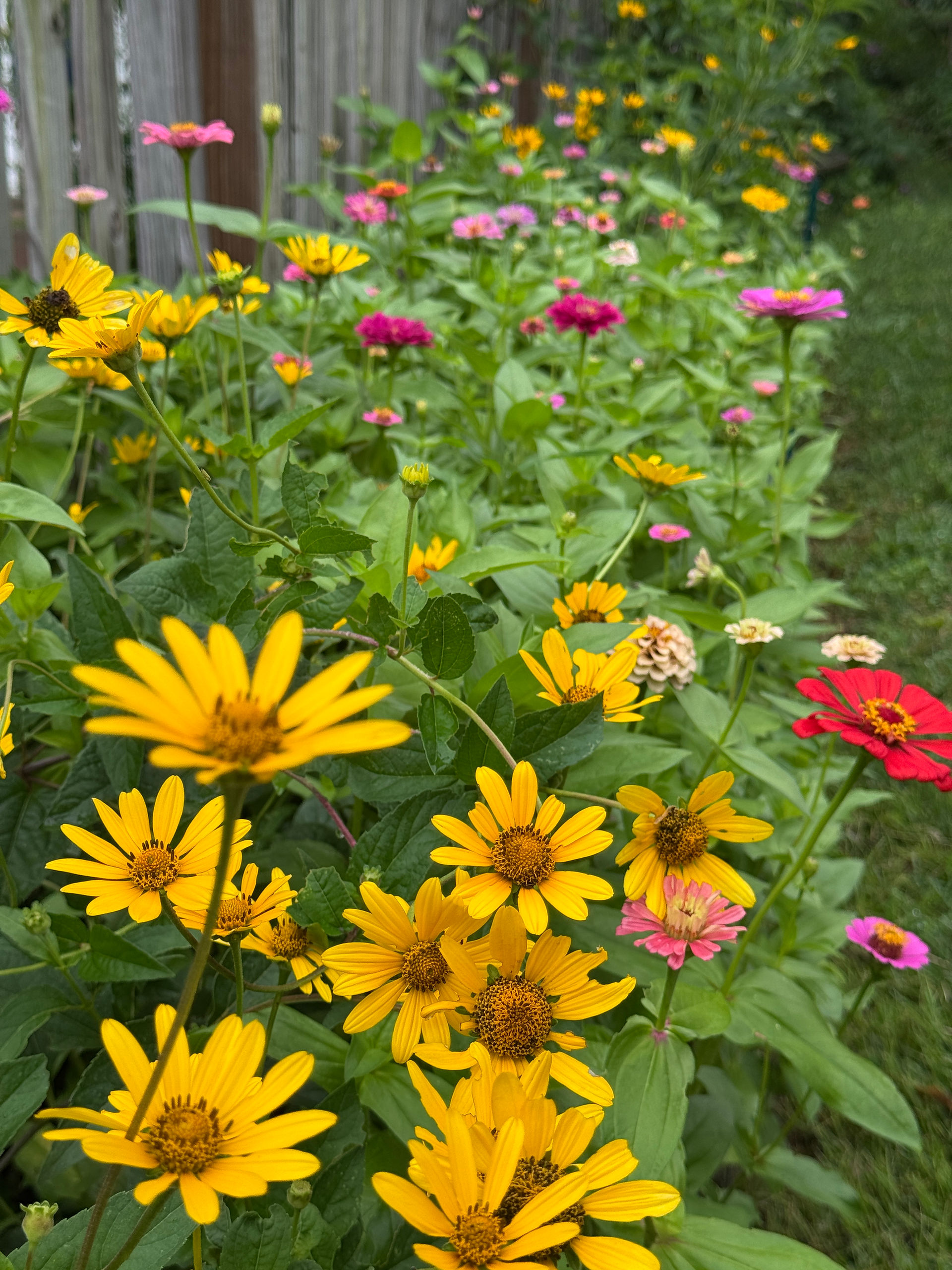
zinnia
And I did spy a wheelbarrow filled with more rocks so who knows what project Kathleen might take on next? One thing is for sure. It will add to this exquisitely personal garden so filled with family history and beauty.
Happy Gardening.


What a great idea to splint a broken stem. I had no idea that was possible. And thank you for all the photos that show how beautiful this garden is. I can recommend Penstemon as a vigorous spring bloomer. The bumblebees adore it, and the flowers bloom for weeks. That and blue-eyed grass are my go-to plants for spring.
I must disagree with the comments on Cut-Leaf Coneflower (rudbeckia laciniata). My absolute favorite native perennial. I have had both for many years. The straight species for me spreads like an aggressive groundcover, has shorter stems with smaller flowers and fewer pollinators. Fine for a naturalized area, but overwhelming for a home garden. My cultivar ‘Herbstsonne” has manageable, slowly enlarging clumps, It has larger more upright foliage, thicker stems and much larger flowers and cones. They are consistently smothered in insects of all types including butterflies and, when the cones ripen, small birds. In early August I cut them back a few feet and they will rebloom until frost and those cones I leave all winter.
Is this zone 7? Inkberry holly seems to struggle with our zone 6 winter here, they look great as the backdrop against the coneflowers in her garden!
What an heirloom she is growing! It reminded me of course, of the philosophy of Mt Cuba Center, “conservation by addition.” If you love some of the exotics/legacy plants, then there’s nothing wrong with including them.
And that Asclepias & Monarda ‘Raspberry wine’ look terrific together. Your pics are great, and labeled even with links to more info! You really write a beautiful & useful blog 😃
Maybe we could persuade you to do another post about the pond? I’d love to see more pics of that. Dimensions? Mechanics? Maintenance? Thank you!
What a gorgeous garden. Thank you for sharing the information about the splint. I wish I'd thought of it about a month ago.