


A Little Summer Garden Inspiration!
Native plants and cool ideas.

This photo of sunflowers (Helianthus annuus) in a highly urban environment has stuck with me for several years now. It represents everything a plant can do for us: adding unexpected cheer, demonstrating the power of plants and teeing up possibilities, so many possibilities! I'm sharing just a few of the photos from gardens and gardeners that never cease to amaze. I hope you enjoy.
Containers with Contrast

Pickerel weed (Pontederia cordata) is an aquatic plant that is pretty darn tough. It naturally grows along shoreline, partly in the water, and partly out of water. At Wave Hill Garden in the Bronx, New York, placing the robustly growing perennial in a heavy container is a great way to formalize its tendency to spread. Love that contrast between the formal and the wild! I inadvertently had my pickerel weed out of water for several weeks this past spring and it looked like it had died but once placed back in water, it came right back. This plant thrives in full sun and will grow in part shade as well. It flowers in summer through fall. Because standing water is a breeding place for mosquitoes, I would either use a mosquito dunk or add a couple of eastern mosquito fish to a container like this.
Perennial Power
sedge and phlox sunny perennial & shrub border
Mt. Cuba Center is a boundless source of inspiration. The planting above left in dense shade is calm and cooling -- a sedge, Pennsylvania sedge (Carex pensylvanica), I believe, and large leaf phlox (Phlox ampifolia). While large leaf phlox may be hard to find, this effect could be achieved with blue mist flower (Conoclinium coelestinum) as well.
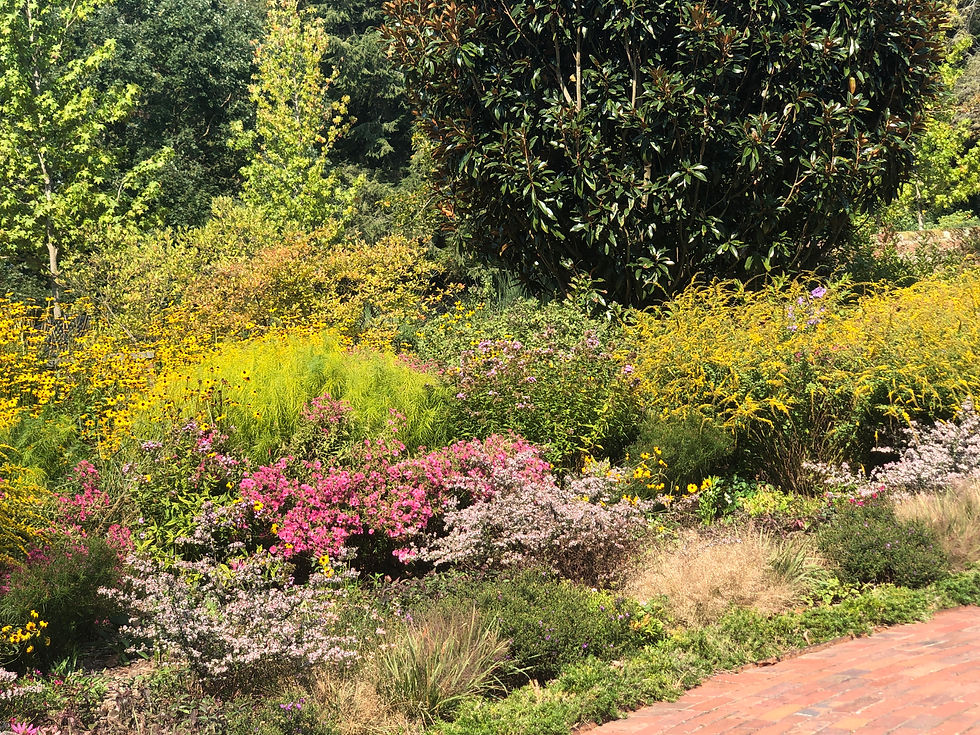
The perennials in the two full sun borders all thrive in full sun. Those in the third photo take drought without a thought. Massing groups of plants like this, give plants which could be pretty wild a bit of structure - a great way to grow these.
Crisp Edges

Speaking of structure, this photo of author and podcaster Margaret Roach's garden in spring shows the value of keeping edging neat. Another way to bring order to meadow type plants like asters and goldenrod is to border them with a crisp edge. It's a cue to care as they say! The easiest time to do neaten lawn edges is right after a soaking rain. It's amazing what a neat edge can do in a garden.
Fresh Flowers

Anise hyssop (Agastache foeniculum), once established, will look fresh most every day during the second half of summer and usually well into fall. Long bloom period, easy to start from seed and the number of pollinators it attracts make it so very welcome and reliable for those hot and sunny days. This plant is native to the midwest prairies and west. There are two groups of agastache, one native to the US and one native to Asia. Some of the commonly available cultivars, like 'Blue Fortune' and 'Black Adder,' are crosses of the Asian and American varieties. These plants grow well in sun and part sun and a range of soils. They need good drainage, particularly for winter. If your hyssop doesn't over winter, it may be that the soils did not drain moisture away from the plant and it rotted.
Creative Containers

This brilliant hanging container belongs to gardener Camille Paulsen (@tahomaflora) outside of Seattle. A fallen tree limb presented the opportunity. She and her husband carved it out, added a liner and hung it on this pergola. This is beautifully filled with mosses and orchids.
stonecrop christmas fern foamflower
Here in the Chesapeake, I can envision it filled with mountain stonecrop (Sedum ternatum), christmas ferns (Polystichum acrostichoides) and foamflower (Tiarella cordifolia). I love the reuse here and it reminds me when it comes down to it, almost anything, with a few holes drilled into the bottom for drainage, can be used as a container for plants!
Cool Blue
blue cardinal flower blue lobelia
Blue cardinal flower (Lobelia siphilitica) is one of my favorite height of summer perennials. This photo was taken several years ago in my garden and today I have a few random clumps of lobelia, nothing like this. I have come to accept that some perennials are short lived - meaning they last for a year or two and then slowly disappear. What is short lived for me might be different for you. What my blue lobelia do well is to self seed into sunny moist areas. So, now, I leave the flowers I have standing so that they will dry and self seed. In late spring, I transplant the emerging plants, essentially basal rosettes, back to this area. To recreate this photo in full though I'd would have to add new plants beyond what I get from self sowing.
Cozy Nooks

This photo, from a show garden in the U.K., reminds us of the charm and utility of a cozy seating area. Not everyone can carve out a small terrace for a bench, but most of us can create a seat or two from which to enjoy our garden, no matter how small or large.
Magical Moments

As you know though, the best inspiration of all comes from nature. I am so hoping you are enjoying little moments like this in your summer garden.
Happy Gardening.


My husband turned a tree stump into a planter by chiseling out the center to create a “bowl” and drilling some drainage holes. We filled it with soil and added Lantana which has done well and attracted many butterflies this summer!
Anise hyssop is a magnet for bees, butterflies and birds. Goldfinches hang out on the flower heads and eat the seeds. So delightful to watch!
Wow, so much inspiration here. Thanks for sharing these great ideas on using native plants in creative ways! PlantPostings.com
I have got to get to Mt Cuba. Beautiful ideas. I definitely need help having crisp edges! LOL
I'm learning to edit the burnweed away from my front door. I've been letting it do as it pleases, but it creates the opposite impression of these vignettes and cues to care. I've figured out a distant spot where it might do okay. I hope
Thanks Shari! Beautiful ideas!