


Takoma Park Native Garden: A Journey in Every Sense of the Word
Sally has seemingly done it all during her journey to create a backyard (and front yard) habitat out of a 1/2 acre lot with thick stands of bamboo (Phyllostachys aureosulucata), Japanese honeysuckle (Lonicera japonica), vinca (Vinca major) and English ivy (Hedera helix). Sally got her start ten or so years ago, when one friend asked her when she was going to plant some trees and another said parts of her yard needed work. Sally could not have known then she would eventually read over 100 books on gardening, become an expert in stormwater control, and navigate a health crisis of a family member with gardening as her anchor. This is exactly what she has done. Drawing on influences near and far, she has removed almost all of the invasives, created little journeys around her garden, foiled the deer and planted lots of natives. Sally shared her story with me because she says "she wants everyone to experience the joy of native plants."
Sally and her husband live in a hundred year old house on a sloping lot in Takoma Park. Initially enamored of the house, not necessarily the garden, she and her husband set about creating a home for their two sons. The sunny grassy lawn out back was a plus with two active kids at home. The invasives on the edges were not top of mind.
A former neighbor, who worked for an environmental organization, had once talked to Sally about native trees. While the neighbor did not explain the ecological underpinnings, Sally had the idea somewhere in the recesses of her mind. When she decided to do something with the garden, she called a landscaper and asked him about native plants. He replied well "God loves all the plants." And that began her native plant quest. She began reading and delved into the world of native plants, ornamental plants and all things gardening. First, during the Pandemic, and then as a loved one faced a health challenge, Sally says the gardening books and thinking about gardening got her through it all.
Sally has an artistic eye, honed through her work as an Art Director in the advertising world. She has combined that experienced eye with loads of practical information needed to beat back the various invasives, address numerous drainage issues and create an artistic garden space all of her family and friends can enjoy.
Invasives: Bamboo, Japanese Honeysuckle, Vinca and English Ivy

In her readings, Sally quickly realized she would need to tackle the stands of these four common and persistent invasives. Armed with her new knowledge, she used different techniques to remove different plants. The bamboo stand on one side of the property was thick on both her lot as well as two adjoining lots. She didn't attempt to remove it until her neighbors were ready to do the same, knowing the effort would have been futile without having it all removed.

river birch 
red chokeberry 
river birch
They brought in machinery for this one. The Merrifield Gardens landscaping team used a small bobcat to dig up and out the extensive root system from the properties. Today, this is the most graceful circular fire pit ringed with river birch (Betula nigra) and red chokeberry (Aronia arbutifolia) shrubs loaded with fruits.
mulched path mulched path
Where bush honeysuckle once stood, eight new trees including an oak (Quercus), a hackberry (Celtis occidentalis) and five understory trees thrive today. A combination of Virginia sweetspire shrubs (Itea virginica,) foxglove beardtongue (Penstemon digitalis) and asters (Asteraceae) as featured in Rick Darke's book "American Woodlands" fill the area beneath the grove of trees. Mulched paths bordered by edging made from fallen branches weave among the various tree trunks. The vinca and English ivy was pulled by hand, "therapeutic" Sally says. These are almost all removed at this point. Covering the newly bare ground is where the gardening began.

mixed shrub border 
winterberry
Screening with a Hedgerow of Plantings
Tucked away in another corner of the lot is a salt water hot tub completely screened from the garden by a layers of inkberry (Ilex glabra), fothergilla (Fothergilla major), bayberry (Morella pensylvanica) and blueberries (Vaccinium corymbosum). Privacy was important in this area. Rather than plant a row of arborvitae, as we often see in landscapes, a mixed border of shrubs adds privacy for the hot tub area, creates a layered habitat for the birds and is a far more interesting way to screen an area off. The rear of
the hot tub area bordered with thriving winterberries (Ilex verticillata).

twirled Virginia creeper vine 
native honeysuckle
Foiling the Deer
Sally’s backyard neighbors have deer regularly. Sally has deterred the deer with a simple but deviling to the deer system of winding vines, mostly pulled Virginia creeper (Parthenocissus quinquefolia), twirled into wavy shapes above the four foot fence. Sally has planted and espaliered native honeysuckle (Lonicera sempervirens) on her side of the fence. The deer are confused and or deterred by the combination of fence and irregular vine shapes above the fence. In the front, Sally uses a system of sheperds hooks and bamboo poles. Sally’s neighbor says these creations look a bit crazy but hey, if it fools the deer, crazy it is!

The Camino
The gardeners here have dubbed the back alley of the garden which runs along the rear fence the "Camino." And a camino it is. At about three feet wide, the clear path allows complete access to the rear of the garden beds that are planted with mature trees and shrub layers. Creating easy access like this is such a brilliant idea if you have the space.

pineapple sage 
blue sage & mountain mint
Using Non-Natives
Sally is all in on natives and she also wants her garden to look like a garden, she says. This means she uses non-natives at key points and times in her garden. A thriving stand of pineapple sage (Salvia elegans) blooming in late October adds a punctuation point to the backyard garden during the lull between fading summer flowers and brilliant fall colors. A blue sage (Salvia azurea) interplanted with mountain mint (Pycnanthemum) creates a beautiful silvery palette as a contrast to the bright colors of fall.

paperbush in fall 
paperbush in fall 
paperbush in winter
A gracefully shaped mound of paperbush (Edgeworthia chrysantha), native to China and the Himalayas, adds elegant blooms in winter. Sally says its fragrance fills the entire space.

Christmas ferns bluestar
Underplantings
Every tree is underplanted. Ferns beneath river birches, the paperbush beneath a river birch and Christmas ferns (Polystichum acrostichoides) beneath a mature beech tree show how creative these combinations can be. Blue star (Amsonia hubrichtii) is planted en masse beneath the hackberry tree, to great effect. It just shows how many possibilities for creating soft landings for insects are possible.

blue star 
'Gro-Low' sumac 
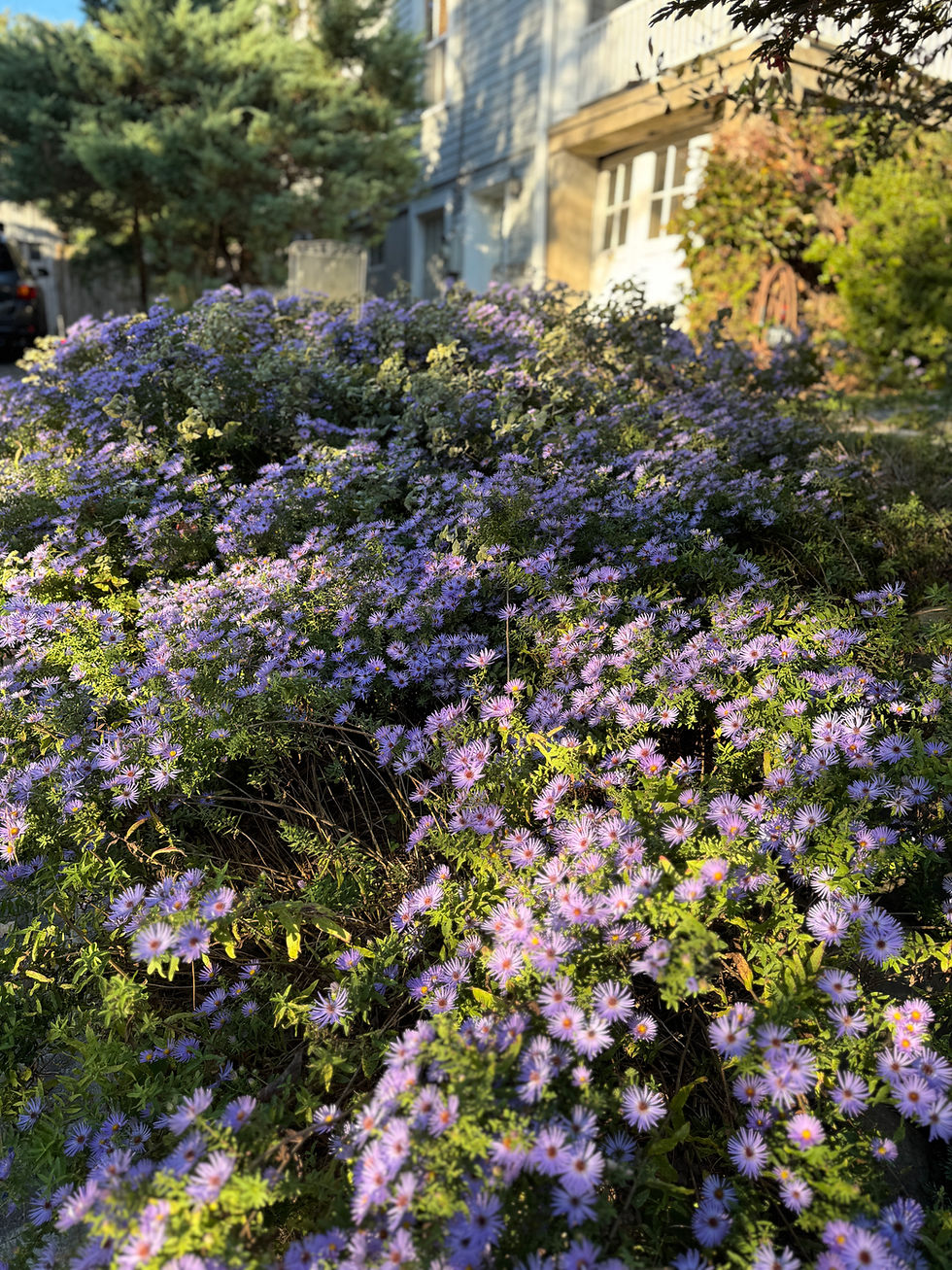
asters
Keeping the Front Formalish
As Sally enthusiastically talks about her garden, a sensibility for making sure this is appealing to all kinds of people weaves through. She really wants everyone to try these plants. It is not by accident I think her front garden uses large drifts for cohesion and readability for non-gardeners. Drifts of blue star along a path, Gro-Low sumacs (Rhus aromatica'Gro-Low') along the sidewalk and asters bordering the pervious driveway are plantings with broad appeal.
The journey of creating this garden, interwoven with the realities of life, is a layered and complex one. The garden today is beautiful, eminently useable and simply gracious. So many lessons to learn from this. Thank you Sally!
Happy Gardening.


Comments