


Native Fall Stunner: A Perennial with Fuchsia Stems and Nearly Black Berries
Are you a yes or no on this plant?

Poisonous Plant
I have long hesitated to write about the perennial native, pokeweed (Americana phytolacca), because of its toxicity. If you google pokeweed, you will quickly learn pokeweed "is quite poisonous." According to the North Carolina Extension Toolbox, pokeweed has medium severity poison characteristics. All parts of the plant are poisonous if ingested and it can cause contact dermatitis. It is toxic to mammals if ingested so that includes humans, dogs and livestock. Mark Manning, in a class for Mt. Cuba, noted "Regarding ingestion poisons: some of the more common native poisonous plants include (but are not limited to) jack-in-the-pulpit, water hemlock, swamp milkweed, Indian hemp/dogbane, rhododendron, mountain laurel, pokeweed, and white snakeroot."
It's interesting because I would never hesitate to write about swamp milkweed, rhododendrons or mountain laurels. The North Carolina Extension Toolbox recommends leaving a few in your garden for birds. Regardless of whether you decide to allow it in your garden, it's hard to miss the stunning late summer and fall colors of pokeweed.

Pokeweed in the Landscape
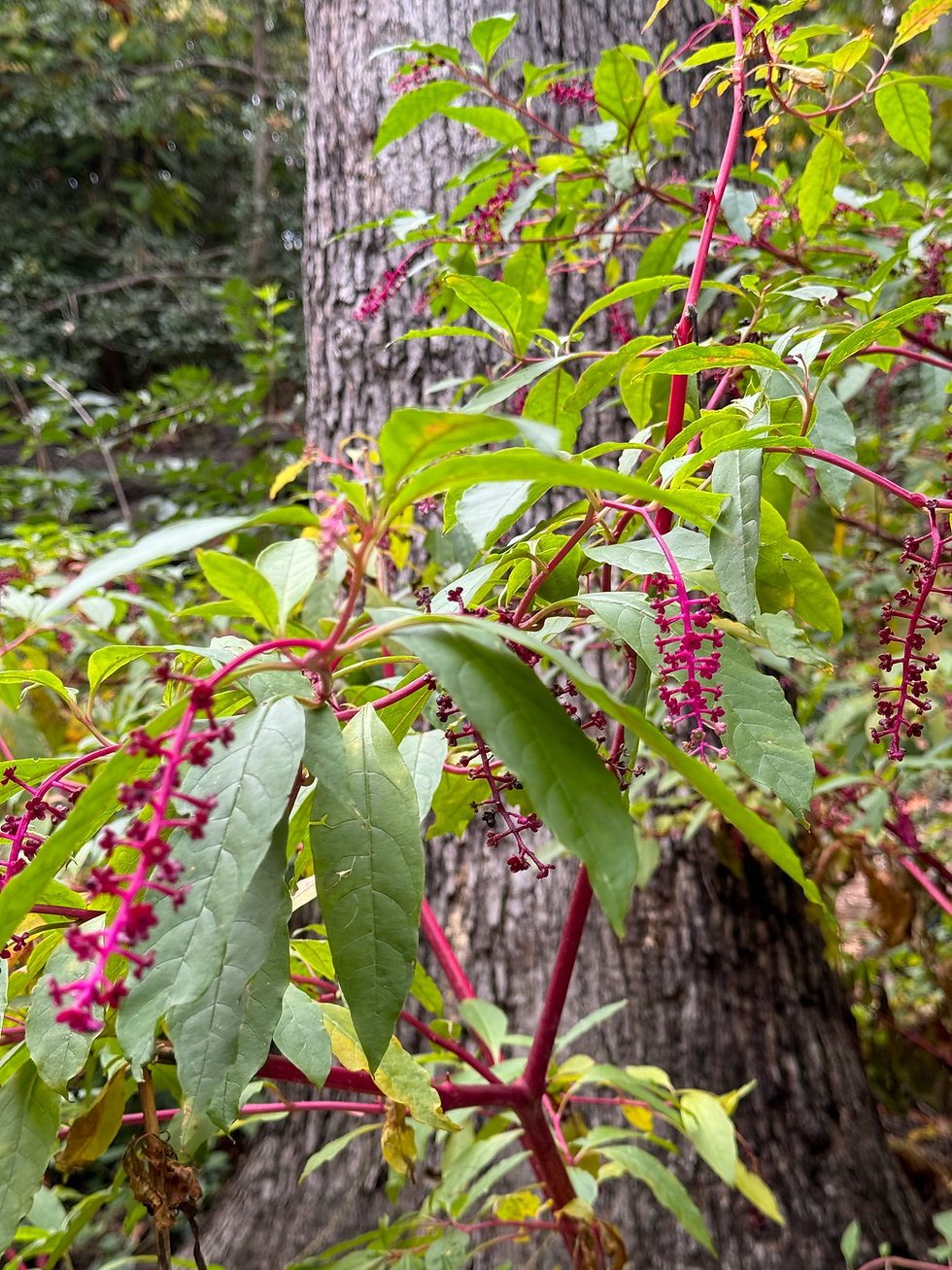
Pokeweed is quite prevalent in our landscapes in the mid-Atlantic. At this time of year, with its bright pink stems, foliage fading to lime green and it's drooping dark purply black berries, it is very easy to spot. It is tropical looking in its appearance. On a recent dog walk, I saw it growing along the sidewalk bordering a busy soccer field, along the edges of a park and in a neighbor's garden. Pokeweed is not poisonous to birds as they are not mammals. Quite the opposite - birds love it and spread the berries prolifically.

This plant can grow up to six to eight feet in a season. It grows in shade or sun. This one growing in full sun in a public garden in Howard County, Maryland is producing loads of berries. The roots of this plant are tuberous and grow deep. It is very easy to pull out seedlings which appear, typically in early summer. As the plant grows, it gets harder to pull and you may have to dig it out.

One of the more interesting things about this plant, is that here in the U.S., it is often considered a weed. In the U.K., it is considered an exotic plant, desirable in the fall garden and hard to come by, because with a deep tap root, it does not grow well in a pot. In the U.K. gardeners know of American pokeweed and an Asian pokeweed, though it seems like the American species is more favored. In the U.K., sellers say "it is toxic to mammals if ingested." Fiona Edmond, owner of Green Island Gardens, a twenty acre garden north of London in Essex has a very helpful 6 minute video on all things Phytolacca, including what the roots look like.
Growing Pokeweed

pokeweed flowers 
berries beginning to form 
after cold temperatures
I have never seen American pokeweed for sale. If you are gardening in the mid-Atlantic, it may show up at any time in your garden, courtesy of the birds. It grows equally well in sun or shade. In full sun, it tends to produce berries earlier than if grown in shade. If you do let it grow in your garden, by the end of summer, depending on its location, it might be a large shrub or a small tree. It flowers with very tiny white flowers in summer and early fall. Those small flowers form droops of berries which turn from white, to green, to purple and then almost black. The stems begin to turn vibrant pink later in summer and fall. Once pokeweed is hit by frost, the entire plant will brown overnight.
If you do find it growing in your garden and you want it to continue to grow, it needs absolutely no care. No watering at all. It is one tough plant. It is always prudent to wear gloves when handling this plant. Pokeweed is native to the southeast U.S. and considered invasive in some parts of the western United States.
What Do You Think About Growing It?
During some years, I let it grow and in others, I remove it when the plants are small. For me, my dogs have never really been plant eaters and there are no unsupervised kids in the garden. If it pops up along my long fence line, I generally remove it because I do see people along the sidewalk touching plants all the time. If it lands in a place in my garden where it makes sense and isn't near the edge, I leave it to its devices!
What are your thoughts?
Happy Gardening.


Comments