


Putting a Native Plant Spin on a Typical Landscaping Proposal
So many plants to choose from!

Right now, in early fall, is a phenomenal time to plant in your garden. Temperatures have cooled. The soil remains warm giving new plants time to establish before winter sets in. Like many of us, my relatives in Cleveland (USDA Zone 6) requested a proposal from a landscaper they trust to spruce up the front door area of their home. They are pretty avid gardeners but, as is the case for many people, fall is a busy time, and they decided to call in a pro.
They initially asked the landscaper about including native plants and, to his credit, he said he didn't really specialize in those and if that is the direction they wanted, he might not be their guy. Liking and trusting him, and being busy, they asked for the proposal. It included one native perennial and possibly a native tree, depending on the species of tree selected. What really struck me about the proposal was how common the proposed plantings are and how there are many readily available native alternatives for every plant. I asked if I could share it with you and here we are!
Proposal
"Plant material installation:
6- 24” Pyramidal Boxwoods
6- #1 cont. Japanese Forest Grass
10- #1 cont. Variegated Liriope
3- 18” Karen Azalea
1- 2” Cal. Flowering Dogwood
3- #7 cont. Quickfire® Hydrangea
6- #1 cont. Little Spire Russian Sage
6- #1 cont. Autumn Blaze Sedum
6- #1 cont. Zagreb Coreopsis "
I'm guessing whether you live in a rural or urban area you can think of places nearby where you see these plants. That is for good reason. With the exception of boxwoods as of late, all of these plants are very easy to grow and adaptable. Boxwoods have been affected by boxwood blight, first discovered in Connecticut in 2011, and now common on the east coast and found in the northwest and parts of the midwest according to various Extension Service offices. It is very hard to treat for, spreads readily and kill boxwoods quickly. So probably best to avoid those at this point. I also have read that plant breeders are developing blight resistant plants but why go through all that, when you could plant a native!
Let's take a look at the native alternatives that are out there. With a tree, shrubs and perennials, these plants will provide a myriad of functions. The tree has the potential to support dozens of different types of insects, food for songbirds, some of whom need a couple of hundred insects a day to see their hatchlings to fledgling stage. Flowering shrubs can do the same. Flowers from all of these plants with long periods of bloom provide pollen to pollinators. Grasses prevent soils from drying out and can provide cover for smaller mammals. And then there are the aesthetics of these plants. It's a nice mix of plants with various textures and attributes to create a pleasing planting.
Dogwood Tree

Chinese dogwood in spring 
native dogwood in spring
The proposal called for a "dogwood" and a Chinese dogwood (Cornus kousa) was discussed. The Chinese kousa dogwood, from Asia, is similar in shape and size, bloom time, and seasons of interest to our native dogwood (Benthamidia Florida, formerly Cornus Florida). The two trees grow in similar light, soil and mositure conditions. Our native dogwood is also native to all of Ohio.

Chinese dogwood 
native dogwood 
Chinese dogwood 
native dogwood
Both trees bloom with captivating white flowers in spring, have beautiful fall color and produce red fruit or drupes. The Chinese dogwood produces red fruit the size of cherries and our native dogwood produces small red drupes that look like seeds. Birds eat both.
The key difference between these two trees is the ecological value in our landscapes. Dr. Doug Tallamy's research tells us native dogwood trees support at least 111 species of native insects. A tree native to China would not typically support insects living here because the two have not co-evolved over thousands of years. Another way to look at it - all of the insects that love the Chinese kousa live in Asia!
Another difference between the two, some will note, is disease resistance. The North Carolina State Extension Toolbox tells us the Chinese dogwood is very disease resistant. You may have heard that our native dogwoods, at one time, were afflicted with anthracnose, a fungal disease. In our area, some nurseries stopped carrying native dogwoods because of the disease but then began carrying them again as the threat of disease seemed to have lessened and disease resistant varieties became available.
Evergreen Shrubs
The proposal includes six pyramidal shaped evergreen boxwoods (Buxus) at about two feet high. Since this is for the front of the house near the door, I assume the boxwoods are intended to remain fairly short so as not to overwhelm the entrance. This would require regular pruning to maintain the desired height and shape over time.
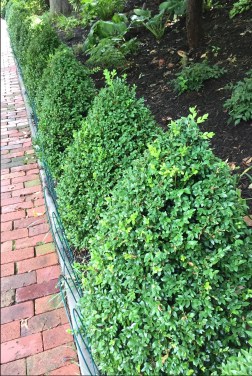
boxwoods 
inkberry 
inkberry shrub
To get that small leaf shape and the same texture as the boxwoods, a natural native choice would be inkberries (Ilex glabra). Straight species grow up to six feet high and wide but cultivars like 'compacta' (Ilex glabra 'compacta') keep to the smaller side and are widely available. Both boxwoods and inkberries are evergreen and grow in sun to part shade.
The issue with substituting inkberries for cone shaped boxwoods is it is not possible to prune inkberries into cones. In fact, an inkberry's natural growth inclination is to do the opposite, grow in a vase shape, so wider at the top than the bottom. If you were not set on the cone shape, the inkberry would work. The vase shaped inkberry shrubs would create a more relaxed look than cone shaped boxwoods.

If you are set on the cone shape, another alternative would be a cultivar of northern white cedar (Thuja occidentalis). These trees naturally grow in a cone shape and can be pruned to maintain the desired shape and height. It would be best to select one of the narrower and shorter cultivars such as Holmstrup Arborvitae (Thuja occidentalis "Holmstrup').

azalea x 'Karen' 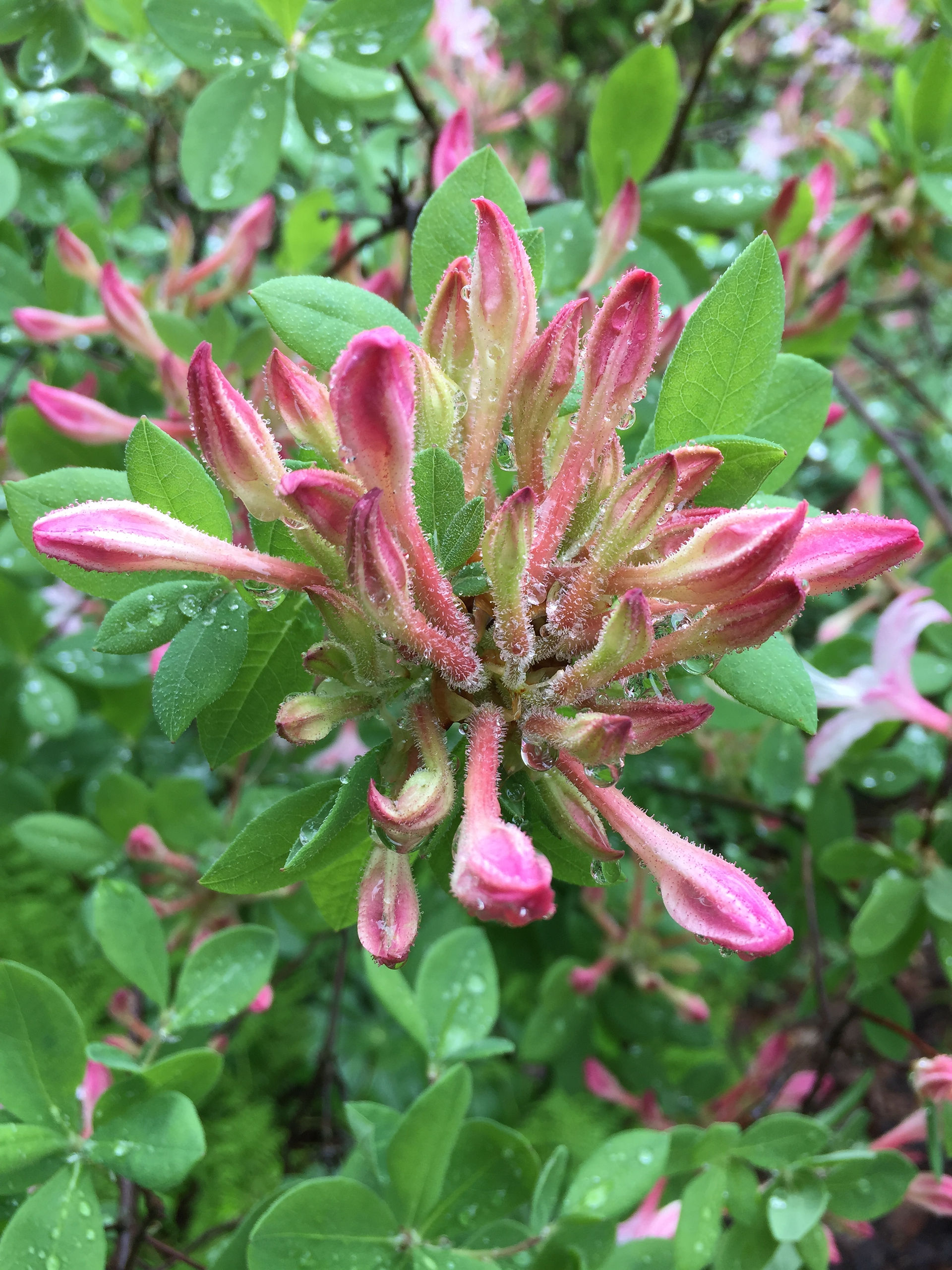
native pinxterbloom azalea 
native pinxterbloom azalea
The proposal also includes three azalea 'Karen' (Azalea x 'Karen'), an Asian evergreen azalea with lavender blooms that grows about five feet high and wide. This azalea blooms in spring and remains evergreen for the remainder of the year. A substitute would be a native azalea like the pinxterbloom azalea (Rhododendron periclymenoides). Native azaleas are not evergreen and grow larger. They also grow in what I would call more architectural shapes than a traditional foundation plant. They can grow up to 8 feet tall when fully mature and can easily be pruned to a lower height. The flowers of the native azaleas are much larger and intricate than Asian azaleas.

native viburnum 
native winterberry
Native azaleas are exquisite if you have their growing conditions: acidic soils, good drainage and moisture. They bloom in spring and some provide a bit of fall color. Another option is to go with a shrub that provides more than spring interest. Many native shrubs flower in spring, produce berries and brilliant fall colors though they are not evergreen. Native viburnums (Viburnum nudum) and winterberries (Ilex verticillata) come to mind.
Deciduous Shrub

'Quickfire' hydrangea 
oak leaf hydrangea 
oak leaf hydrangea 
oak leaf hydrangea 
oak leaf hydrangea 
oak leaf hydrangea
The proposal calls for three hydrangea 'Quickfire® (Hydrangea paniculata)' shrubs. These panicle type hydrangea (Hydrangea paniculata) hail from Asia and are popular shrubs, in part because they tend to be more sun tolerant and are cold hardy. They bloom in summer and shed their leaves in fall. The flowers turn from pink to brown as fall approaches. They are large shrubs and smaller cultivars are available.
Native oak leaf hydrangeas also bloom in summer and shed their leaves in late fall. The foliage has the most outstanding array of fall colors ranging from pinks to maroon to oranges and purples. As added bonuses, the papery bark adds winter interest and the emergence of minty green new foliage in spring is ethereal. Oak leaf hydrangeas grow in full shade to full sun and also are available as smaller cultivars.
The big aesthetic difference here is pink flowers in the Asian species versus white flowers in the native species. The four seasons of interest really carry the day for the oak leaf hydrangea shrub.
Perennials

Russian sage anise hyssop
The proposal calls for a compact form of perennial Russian sage called 'Little Spire' Russian Sage (Perovskia atripicifolia 'Little Spire'). Anise hyssop (Agastache foeniculum) is a very similar native substitute, also with a long bloom time.

sedum 
coneflower 
joe pye weed 'Little Joe'
The second perennial included in the proposal is sedum 'Autumn Fire,' (Hylotelephium spectabile 'Autumn Fire'), a very common perennial from Europe and Asia that has established itself in many parts of the United States. It is a long blooming perennial growing to a couple of feet in height. It grows in full sun and is very adaptable to different conditions. Native substitutes include coneflowers (Echinacea purpurea) and joe pye weed 'Little Joe' (Eutrochium dubium 'Little Joe').

The last perennial suggested is coreopsis (Coreopsis verticillata 'Zagreb'), a native cultivar! The plant was cultivated for a shorter and neater growing habit.
Grasses

Japanese forest grass 
Japanese forest grass in fall 
seersucker sedge
The proposal calls for Japanese forest grass (Hakonechloa macra) a grass with four seasons of interest. It is green during the growing season, a vibrant yellow in fall and brown through winter. It is commonly planted for its ability to cover the ground, crowd out weeds and creating flowing drifts of movement. It needs moisture and shade to thrive.
There are a number of native sedges that mimic the evergreen nature and flowing texture of Japanese forest grass. At the top of Mt. Cuba's trials for this is Wood's sedge (Carex woodi i). I'm a big fan of native seersucker sedge (Carex plantaginea) if you have shade. It can take drier soils too.

liriope 
blue wood sedge
The last grass recommended is variegated liriope (Liriope). Liriope is listed as invesaive in a couple of states and is in the emerging as invasive category in others. These listing processes take time and when a plant is in this posture, I think it best to avoid under the basic principle of first, do no harm! The good news is there are so many other grass type plants for shade. You could plant tseersucker sedge discussed above or go with a different color in blue wood sedge (Carex laxiculmis) which is evergreen and adds interesting shades of blue.
Redux
This is a ton of information if you don't think about this stuff all of the time and most of us do not. Prioritization can be one way to approach it. Here, trees and shrubs are covering the most real estate, if you will. They are the largest plants. Trees are also very much a permanent choice for most. We aren't out there on a weekend morning moving the trees around. Well, most of us aren't! Trees also live a very long time. Getting the right trees for your needs is a high priority. Avoiding adding invasive plants is right up there too. The biggest ecological wins would be choosing a native tree and substituting for the potential invasive plants. If you can make all the substitutions, all the better!
As for the Cleveland landscaper, my relatives asked him about native substitutions and he was receptive! It seems like many would be if they just had the information and a place to get the plants. This is why the work of the Chesapeake Landscape Professional Council is so key in our area. The Council trains and certifies landscapers in sustainable practices and publishes a searchable list of landscapers who have completed the training.
Something to think about if you are looking to hire a professional landscaper!


This is great. I’d add that varieties of plants can make a difference: there is now a vertical inkberry available, “Squeeze Box” inkberry, 4-6 x 2-3.’ (PlantAddicts, Sooner Plant Farm mail order nurseries carry, among others). The native dogwood Appalachian series have been bred to be more disease resistant. Another pleasure of native plants, I find, is the varying interest they carry over the seasons - buds, blooms, berries, foliage, bark texture - along with the busy activity of pollinating insects, that make them far more interesting. I’m finding non-native plants to be more static and sometimes flat.
I noticed most of the cornus available in most nurseries nowadays are hybrids, and sometimes they are labeled as kousa. The one on the right in the first photo, it looks like hybrid to me, kousa usually don't have flowers that large and showy! C. florida seems to struggle to get established in my region.
Patty - so great you have found someone who will work with you!
Another great blog! Love the substitution options, hope the landscaper enjoys learning about new plants to offer clients :)
Wonderful post! I am getting ready to replant a large, shady hillside that is now covered in hostas. The deer eat the hostas every year, so I only get to see them for a couple of weeks. The replacements will be Packera Aurea (Golden Groundsel), Geranium Maculatum, and Solidago Flexicaulis (Zig Zag Goldenrod). There are also some Ostrich Fern and Carex Woodii on this hill that I planted since moving in. Love reading articles like yours that help homeowners know about what native plants can be used to benefit the local ecosystem while still achieving the aesthetic of exotic species. Another native I can recommend substituting for the boxwood is Thuja occidentalis, Tater Tot. I replaced my boxwoods with t…