


Winter Garden: Ideas to Make it All Native?
Tuck away possible ideas for planting this spring and enjoying next winter.

I walk by this garden to the front side of a home on an almost daily basis and it always looks good. A mature native river birch (Betula nigra) is densely underplanted with evergreen shrubs, grasses and ground covers. This thick mat of foliage accomplishes so much in a garden.
Reduce Maintenance
First, it makes maintenance a breeze. By shading any bare soil, the plants act as a living mulch. This prevents weeds from germinating and helps the soil retain moisture.
Soft Landing
This type of planting beneath a large tree creates a soft landing -- something highly promoted by Dr. Doug Tallamy and other scientists. Young insects need a place to live once they mature and make their way to the ground. Planting beneath the tree has been shown to significantly increase survival rates for insects. More insects - more birds!
Design Power
Designing with plants can be likened to a painting. Complimentary colors, contrasts, different textures and shapes all add depth and interest. This garden mixes rounded shrubs with flowing grasses and diminutive ground covers. It pairs greens and yellows - always a pleasing combination. It combines many different shapes: long and slender, small and round, straight and short. It all adds up to a simple yet stunning garden.
Plants

This small garden bed, anchored by a mature native river birch tree, is making a big contribution. River birch trees support over 400 types of insects so this garden is doing its part. You can read more about growing river birch trees here. The rest of the plants are not native to the United States. If we wanted to recreate this planting with all natives, it can easily be done!
Swapping periwinkle for a native ground cover

creeping phlox 
Allegheny pachysandra 
three leaf stonecrop
The first best change would be to replace the common periwinkle (Vinca minor), native to Europe. Common periwinkle is considered detrimental to natural landscapes by several states. Removing a small patch like this would be fairly easy and could be done by hand and even more easily, after a rain. There are several native ground cover options for this part shade location. Creeping phlox (Phlox stolonifera) makes a great substitute for periwinkle. It also blooms with lavender flowers in spring and creates a dense covering over soil and is semi-evergreen depending on location. Other options are Allegheny pachysandra (Pachysandra procumbens), and three leaf stonecrop (Sedum ternatum). Each grows in part shade, would add a different texture to this design and new shades of green.
Swapping Japanese forest grass for a native perennial

bluestar 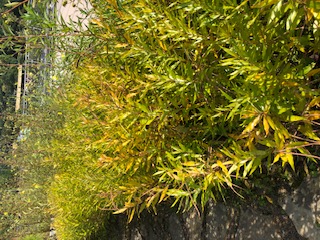
wideleaf, willow or eastern bluestar
Japanese forest grass (Hakonechloa macra) is a commonly planted perennial and it's easy to see why. It is very low maintenance and adds graceful waves of movement when planted en masse. There are several cultivars with varied shades of lime green in summer and gold hues in the fall. Beautiful.
Without a doubt, the best native substitute to recreate the rich contrast with evergreens in fall is bluestar (Amsonia hubrichtii). Native to parts of the southeast, the feathery foliage of this perennial turns a bright gold in fall. Wideleaf bluestar (Amsonia tabernaemontana), also called willow leaf or eastern bluestar, is the amsonia native to the mid-Atlantic and also has a deep gold fall color. Once amsonia are established, they will mostly shade the soil. To create a carpet, plant bluestars closer together. One thing to note about bluestar: it can take a good four years to really get established so it requires a bit of patience. While establishing and once mature, it is a very low maintenance plant.
Swapping yew and boxwood for native evergreens

inkberry 
eastern red cedar 'Grey Owl'
Substituting inkberry (Ilex glabra) for boxwood (Buxus) and eastern red cedar 'Grey Owl' (Juniperis virginiana) for yew (Taxus) are easy native choices to make. The evergreens are all easy care and provide the deep contrasts that make this planting so noticeable.
This garden planting stands out for so many reasons -- the colors and low maintenance are hard to beat. Amping up the ecological benefits of the river birch with more natives is just icing on the cake! Well, as a reader below pointed out, for many insects, having a range of native plants beneath the tree, might be more than icing on the cake. It can be essential food those insects need to survive.
Around this time of year, we can become weary of winter. It's a great time to note what you might want to plant, once things warm up, to make next year's winter garden even more special.
Happy Gardening.


There is are low growing, spreading Amsonias!
Amsonia 'Georgia Pancake' is the best choice for a low-growing, spreading, groundcover-type Bluestar, featuring needle-like foliage that creates a 1-foot tall, 2-foot wide carpet. Other excellent low/compact options include Amsonia montana 'Short Stack' (10 inches tall) and the compact Amsonia 'Blue Ice'.
Plant Delights Nursery
Plant Delights Nursery
+3
Top Low-Growing & Spreading Amsonia Varieties:
Amsonia 'Georgia Pancake': Spreading, prostrate stems with soft green, needle-like foliage; turns golden yellow in fall.
Amsonia montana 'Short Stack': A dwarf form of the native species, reaching only 10 inches tall and spreading roughly 18 inches.
Amsonia 'Blue Ice': Compact, mounding, and very floriferous, forming 12-16 inch high mounds of deep lavender-blue flowers.
Amsonia tabernaemontana v. montana:…