


Simple Native Perennial Combination for Full Sun in August
Updated: Aug 5
Perfect for beginners and seasoned gardeners.
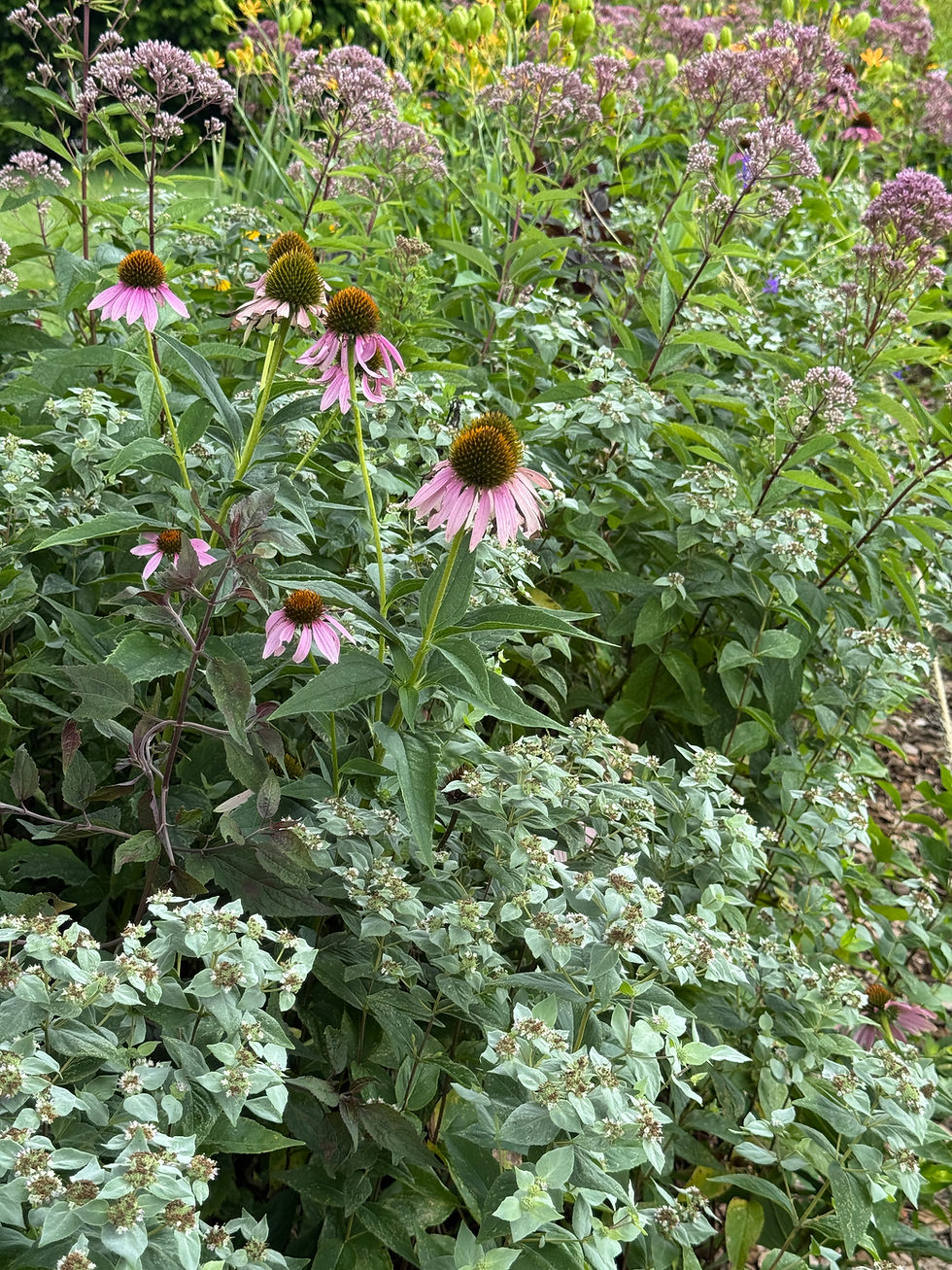
Flowering perennials looking fresh in August can be elusive. In a drought filled year, even more so. This combination of tough and easy to grow plants caught my eye for its simplicity and ease. The cooler color palette might be a welcome alternative to brighter colors in an already hot month. Somehow, the paler tones just add a sense of calm in August. And best of all, these plants are so easy to find in nurseries, garden centers or on-line.
In full sun, these will thrive. In part sun or part shade, the coneflowers will bloom, but not as profusely. The mountain mint and joe pye weed will grow but with more of a tendency to flop. Once established these plants should be fine without supplemental watering. Give additonal water during dry periods and you may get longer lasting blooms.
Perennial Coneflower

coneflowers 
coneflower
Coneflowers (Echinacea purpurea) are native a bit further west of the Chesapeake watershed. As you likely know, goldfinches love the seeds and the blooms attract a variety of pollinators. The flowers are very long lasting. In my garden they bloom from June through August.
You can deadhead to encourage more blooms or not. If you decide to remove faded flowers, try to cut down to a pair of fresh leaves where you see a new flower emerging. I like to just chop and drop -- leaving faded flowers on the ground for birds to find (and they do) and with the hope of getting some reseeding underway. Just a note that the first flush of coneflowers will be the most robust. Secondary blooms are often shorter and smaller. I recently read something by a gardener who deadheads coneflowers but purposefully leaves the strongest, most upright spent coneflowers on the plant to create the best winter interest. That makes a lot of sense to me and I'm giving it a try for the first time now.
If you are interested in some of the coneflower cultivars, Mt. Cuba trialed these and released a very helpful report in 2021. Here are their key takeaways.
Perennial Joe Pye Weed

joe pye weed 
joe pye weed and swallowtails 
joe pye weed
Joe pye weed (Eutrochium purpureum) has loads of positive attributes. It blooms in through August and often into September – always a good thing. It’s easy to grow as long as it gets a couple of hours of sun a day. It is also popular with pollinators. There are several types of joe pye weed. The straight species of joe pye weed (Eutrochium purpureum) is a giant, growing to 7 or 8 feet tall. This is perfect if you have a huge perennial bed in a large garden. It’s an excellent back of the border plant. If you want a slightly shorter joe pye weed, try gateway spotted joe pye weed (Eutrochium maculatum 'Gateway') which grows to 5 or 6 feet tall. If you don’t have that kind of space, little joe pye weed (Eutrochium dubnium ‘Little Joe’) might be best for you. It is compact, growing to 3 to 4 feet high and wide. Joe pye weeds thrive in wet soils but seem to grow just fine in average moisture soils. I have not had much luck with deadheading to get more blooms. If you have, please do share your techinique.
Perennial Mountain Mint

clustered mountain mint 
mountain mint in flower border at Hillwood Garden
Clustered mountain mint (Pycnanthemum muticum) is the third of this perennial trio and adds textural and color variation to the planting. Clustered mountain mint is clump forming and versatile in terms of soil and moisture levels. It adds a chill vibe to your garden. Flowers are small and low key. Its long staying power and minty green foliage are its key aesthetic benefits.
In a flower border in the cutting garden at Hillwood Garden in Washington D.C. the clumps of mountain mint add a place for your eye to rest amid the many colors of the other flowers. The periodic spacing also adds a cohesiveness to all that color.
Ecologically, pollinators flock to mountain mint non-stop. Mt. Cuba Center is currently trialing over 40 species of mountain mints and the results will be available in the next year or two. In the meantime, clustered mountain mint seems to be a good bet.
Winter Wins

coneflowers in winter 
joe pye weed in fall 
mountain mint
If at all possible, leave these perennials standing in your garden through fall and winter. Birds will feed on all of these seedheads, typically until all the seeds are gone. These plants each add interesting structure to your garden in the winter months too.

If you grow this combination, please share any tips or your experience and if you know someone who has a hankering to add some native plants to their garden, this strikes me as a pretty easy place to start, even in August!
Happy Gardening.


The seedheads of the mountain mint look quite interesting! Shari, I’m thinking of trying some trout lily (Erythronium) in my garden. Do you have any experience with how it performs? I think it’s about time people started thinking about placing their bulb orders for fall planting.
I grow Joe-Pye Weed in an area that gets morning sun and afternoon shade. It blooms nicely but doesn't get taller than 4' or so. I had 'Little Joe' in a somewhat sunnier spot but it never got taller than 2'. It lasted only a few years and didn't seem as attractive to pollinators, so I'm not replacing it. I have Mountain Mint in the front of the house where it gets morning shade and afternoon sun. It blooms prolifically and spreads itself around. It's easy to pull it from places where I don't want it to intrude on other plants, and pollinators of all sizes adore it, so it's a favorite of mine. It also smells wonderful if…
Mountain mint and purple coneflower! A great combo! :)
I love that mountain mint is extremely resistant to deer, I might even say it's deer proof, which is almost impossible in my garden. The silvery foliage is like the little black dress, it looks good everywhere it grows. You can put any color next to it and it adds visual interest and complements nearby plants. I love a good purple for the same reason-- you can put it next to any color pale or vibrant and it works and makes a great garden accent.
I have a lot of shade, and my clustered mountain mint gets maybe two hours of sun. In my Montgomery County Maryland garden, it's doing great with all the rain this year. Thank you for this post. I'm trying to expand my combinations of plants that bloom at the same time.