


Glowing Up Your Winter Native Garden
- Jan 28
- 2 min read
The secret is layering.

My sense is winter gardens tend to evolve over time. Professional garden designers usually include winter structure in a new garden design from the very start. Structure may consist of hardscaping like pathways, walls and patios, plants like shrubs and trees with interesting structure, bark, colors and evergreens. Structure can be formal or informal. For those who DIY their garden design, my sense is it is the rare gardener who will start early on with winter structure. We are too enthralled with creating the garden one imagines having during the warmer months and all of those flowers!
At least this was the case for me. I added evergreens dotted around the garden later in the process. I thought I was doing pretty well with winter interest. Following the advice so many professionals give to really take a look at your garden during winter to see what the bones or structure of the garden looks like, I realized, in my informal style garden, I have lots of evergreens and shrubs with winter interest but they were dotted throughout the garden. It occurred to me, from studying photos of gardens specializing in winter interest, that not only do those gardens have plants that bring something special in winter, they either repeat it, or layer it.
Massing Plants in the Native Winter Garden
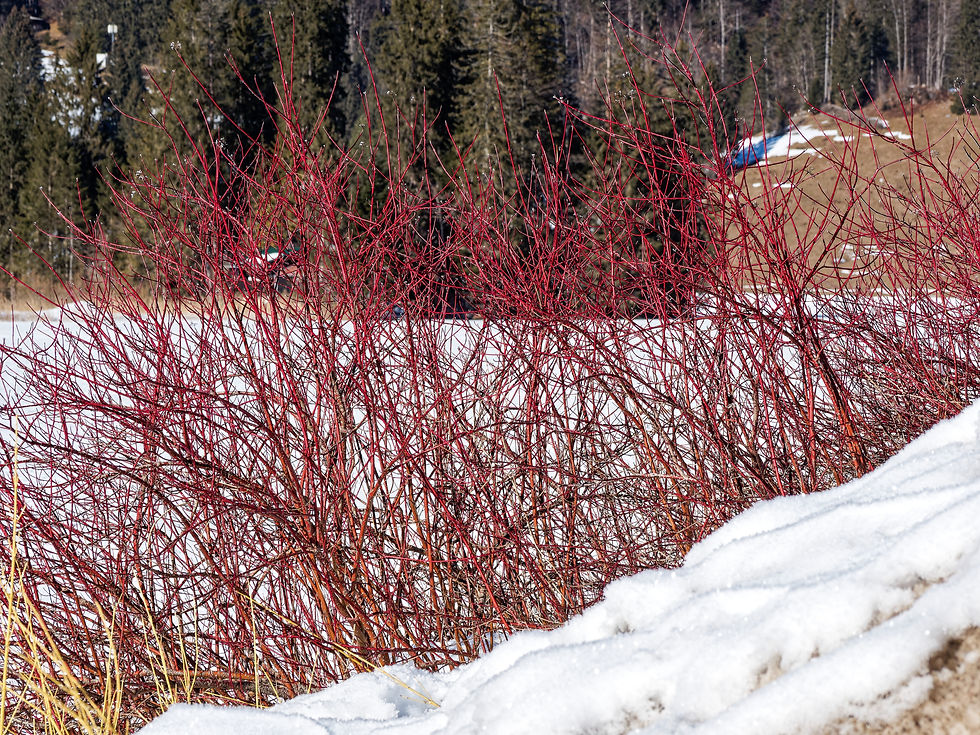
Think about a stand of five or seven red twig dogwoods (Cornus sericea). The collection of massed red stems make those red stems really stand out. Massing is a great design technique for winter and all year round. For smaller gardens though, it can be hard to devote that much space to just one type of plant. In a more diminutive garden. layering winter interest is more practical.
Layering Plants in the Native Winter Garden

Here a trio of eastern red cedars 'grey owl' (Juniperis virginiana 'Grey Owl')in front of an evergreen hemlock tree add texture and blue green color year round. But could this be more?


I first added a yellow twig dogwood (Cornus sericea 'Flaviramea')between the red cedars and the hemlock. It's a bit hard to see in the photo but in person it really added a pop of contrasting color. Better. I then added a dwarf white pine (Pinus strobus 'Nana'). In winter, white pines tend to have a yellow tint to their green needles and both the new texture and color made a big difference. Much better. That's when I realized layering your winter interest adds a little bit of something extra that gives you a glow up in your native garden!
Favorite Native Plants for Winter Interest


With snow on the ground, it is very easy to see your garden's winter structure. It's the ideal time to think about any moves or additions you may want to make in the coming year. Wherever your winter gardening takes you, may it be warm and interesting!
Happy Gardening.


I put cuttings of my red twig dogwood in the pots by my front steps as part of my decorations last year and they rooted. Very nice to have free plants to give to friends. :) Karen Royer
I also love planting trees and shrubs that I can use for cuttings in holiday decorating. Besides winterberry, which is a stunning plant for winter interest, I love Eastern red cedar (Juniperus virginiana) with its blue berries. It was beautiful combined with dried orange slices in my Christmas table arrangements. Best of all, I put it on the deck outside after Christmas and the birds pounced on the berries. Longwood Gardens used red twig dogwood plants throughout their holiday decor in their conservatory.
My front yard has a foundation planting of hollies (mostly nonnative) that were already established when we moved here. I try to layer mostly by adding native perennials of different heights, and because I leave the stems and seedheads, there are shorter and taller plants. But what "pulled it all together" was adding pink muhly grass throughout that space. The color has faded but the fluffy stems and seedheads are still there, and they sway in the slightest wind, so there's movement almost all the time. I think I'd like to add some red-twig dogwoods, though, to get that structure and color during the winter.
Appreciate this insight. For me layering in all seasons has so far been an elusive design element. In part because my primary goal has been to establish ground layer to replace/remove turf grass, liriope, vinca, english ivy, English blue bells, ...i do have a narrow, south-facing border where layering just came to me, not because i consciously layered but because i had a narrow area facingnthe south and framed by a acked wall. . There I have 1st muhley in the most sun-facing, then red twig dogwood, with a couple of arborvitae and a Grey owl juniper against a rock wall. The sun reaches them all because it's south facing, and the colors in all seasons make me quite happy.…