


Tom Horton: Garden Inspiration from the Chronicler of the Heart and Soul of the Chesapeake
August inspiration.

For those of us lucky enough to live within the Chesapeake Bay watershed, Tom Horton needs absolutely no introduction. For those living further afield, Tom Horton has seemingly touched every inch of this great watershed and shares his keen observations about its people, natural history, culture, challenges and more. An award winning journalist many times over, Tom is an avid kayaker and enormously insightful and effective environmentalist. Tom Horton tells powerful stories that inspire through writing, film-making and teaching at Salisbury State University.. In short, he is a living legend. And, he is a native plant gardener!
I am so thrilled Tom offered to share this piece with us.
THE YARD THE MAN THE BAY by Tom Horton
Always suspected peoples’yards say something about their owners. My eighth of an acre plot in the city of Salisbury, MD, is shaggy and cluttered, a study in dishevelment, testament to fecund dishabille, indulgent—but underlain by purpose, great and small.
I began to essay 225 South Boulevard some 15 years ago, now as good as anything I’ve put between the covers of a book. Began it with crabgrass and a shovel, fueled by an aversion to mowing and to raking leaves (still astonishes me how radical that last notion remains).
I had inspiration from reporting trips to some of the world’s finest forests, and from my buddy Nick Carter’s old Choptank watershed farm that he and wife Margaret have been reverting to nature for more than half a century.
Over the years I’ve compared my budding enterprise to a journalist advocating free speech, the soils allowed to utter all their notes rather than drone the tone of lawn. Also touted it for sequestering carbon, slowing and purifying runoff to the Chesapeake, boosting migrators and pollinators and reducing energy use by adding summer shade.

American holly 
river birch 
river birch 
American hollies
But truthfully, I just wanted to see leaves and berries and blossoms out every window of my urban bungalow. Shovel by shovel, plant by plant as budget allowed, a loose plan took shape.
I wanted winter interest, which led to hollies and American osmanthus and interesting bark—river birch, paperbark maples, heptacodium.

common witch hazel 
leatherwood flower 
pinxterbloom azalea
Also to a bevy of witch hazels that blaze in February and March; and a little underutilized bush known as Leatherwood, which not only blossoms reliably in deepest winter, but does it in deepest shade.
Fragrance seemed a good thing, for which I deployed many native azaleas, which blossom springtime and come from seeds collected in the 1950’s along the Choptank River near Nick’s. They are followed by fringe trees, whose May panicles of sweetish, frothy cream tell me it’s time to paddle the nearby Pocomoke River where they festoon the forested banks.
And OAKS! Oaks are hot tickets in the last few years due to the efforts of botanist and author Doug Tallamy, whose research has confirmed that of all native trees they host the best eatin’ for insectiverous nesting birds. I have 11 varieties, from the usual white and red oak, to oglethorpe, georgia, arkansas, turkey, blackjack, dwarf chinquapin and runner oaks, and a couple I forget.
And I hear readers worrying: all those oaks on an eighth of an acre; doesn’t he know they get big? But take a walk in a forest and see how close together many large species grow; and I reserve the right to cut if needed—indeed have long since traded my lawn mower for a cordless pole trimmer.
Not all oaks get big anyhow; and I’ve found species like tulip poplar, which can soar, in naturally-occuring smaller mutations. And my plants grow slowly as I don’t fertilize except to add a compost made of Montgomery county, MD’s raked up leaves (and why are we transporting Montgomery county’s leaves so
far and wide from Montgomery county’s trees...don’t get me started.)

No slave to native species am I, though I’d guess the yard’s more than 100 different species are 75 per cent native. Native to what you might ask—Salisbury, the Delmarva Peninsula, the mid-Atlantic, the Eastern U.S.?
Yes. Even a native of the midwestern prairie, silphium perfoliatium or cup plant, whose deep tap root loves my sandy loam and draws more pollinators than anything I got.
Urban verdureholics like me do have an ace in the hole when it comes to variety—no freakin’ deer, which The Nature Conservancy calls the biggest threat to forest biodiversity in these parts. Rabbits and squirrels and voles do minimal damage. So it is that gnarly sparkleberries reside here with Alabama crotons joined by anise plants and five kinds of dogwood and tropical looking but winter hardy Ashe magnolia whose blossoms can span nearly a foot wide.
Also maples, red and chalkbark, trident and Japanese; and various buckeyes, bottlebrush and red and painted. It’s a funny thing that even a small yard never seems quite full up.

Virginia bluebells 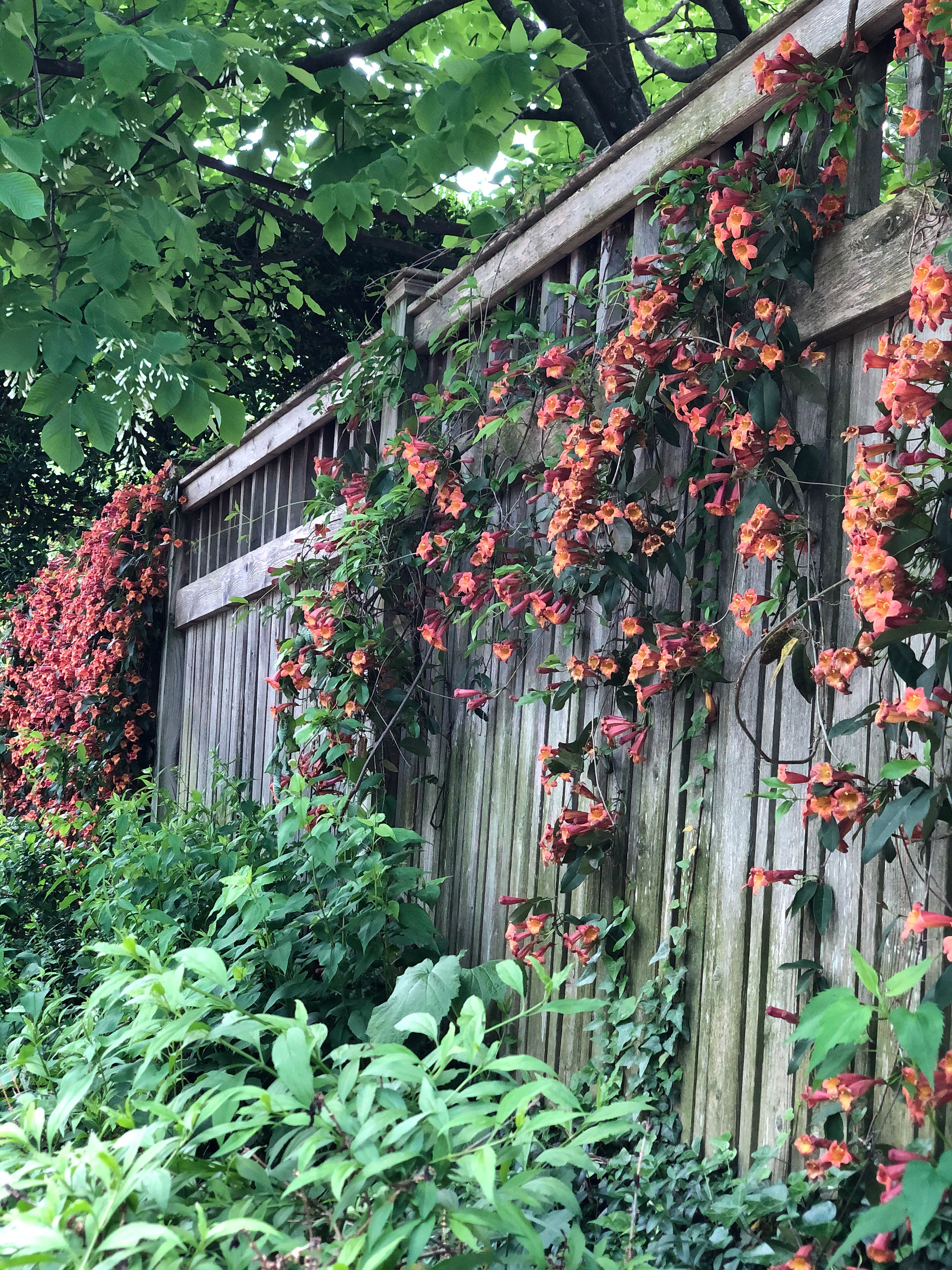
crossvine
About the time I could not cram in another tree (except for that shagbark hickory I stuck in the back corner, and...) I discovered Virginia bluebells and other shade loving groundcovers; and soon as that’s ‘done’, I’m thinking about native crossvine and maybe dutchman’s pipe to train up my back fence where I’ve torn off invasive ivies.
Then there’s probably the best habitat my efforts have wrought. You cannot do my kind of yard without dedicating space for a brush pile, and that is full of songbirds and pretty surely a possum family that nocturnally gnaws on the oyster shells along the drip line of the porch after I shuck some.
My yard has also become something of a memorial in recent years. As loved ones and folks who’ve inspired me die, I ‘name’ a tree or bush for the departed, hanging aluminum tags on a branch (one didn’t depart after I had named a nice longleaf pine after him, but the pine can wait).
For all the Bay/Planet saving reasons to essay this place (I’ve even planted the driveway now), I just purely enjoy all the textures and scents and shapes and botanical knowledge I’ve gained; and the way light reflects off and filters through the plants, how they toss in the breeze as I sip my morning coffee, and my evening wine, and write from my little office shed.
‘I wake up each morning torn between saving the world or just enjoying it’, said the writer E.B. White. With my yard I can do a tad of the former, a ton of the latter.
Thank you Tom and happy gardening.


Please publish more pictures of Tim Horton's garden to inspire those of us gardening with lots of tree shade
I've seen Tom's yard during garden tours and it's amazing how much he has planted in such a small space. Everything looks healthy and beautiful. The funny thing is, having so many trees makes the yard look much bigger than it is. As you walk along the narrow, winding path between the trees and shrubs, you feel like you're miles away from the city streets in the middle of a forest.
Lovely! And I am now on the hunt for leatherwood. I have lots of shade.