


A Native Plant Garden with Colors of the Maryland State Flag?
Indeed, it is entirely possible...

My friends are quite patient with my enthusiasm for native plants and likely have come to expect some sort of deep dive or elevator speech on the fun of native plants whenever the topic of gardens comes up. Even my non-gardening friends know a fair bit about native plants at this point.
When a friend, who I would not describe as an avid gardener, recently mentioned she'd like the garden at her new home to reflect the colors of the Maryland State flag and she wanted to use natives, I had to take a moment! I soon realized she embraced the mantra of anything you can do with ornamental plants, you can do with native plants. So here it goes -- a plant list for a native plant garden that will show the world your Maryland spirit through and through!
Plants for shade and plants for sun. Plants for birds and pollinators. These are the plants to energize your garden by adding buzz and song to every season. These are the plants insects use to reproduce so your garden will come alive. Ornamental shrubs like yews (Taxus baccata), Asian azaleas (Rhododendron 'Atalanta') and boxwoods (Buxus sempervirens) can be a good place for a bird to nest but those shrubs can't feed the birds or the insects the birds need each day to feed their chicks. Take a look and see if you need some more of the red, white and gold in your garden!
Sun
Sunny spots get at least 6 hours of full sun a day. Please don't do what I do and wish for sun by thinking plants for sun can be planted in an area that gets five hours of sun a day. These made for sun plants will not thrive. The more thriving your plants do, the less you have to do. That said, if you have six hours of sun, here are some plants for you:
Fringe Tree

White flowers in late spring or early summer and clear yellow foliage in fall make fringe tree (Chionanthus virginicus), a smaller native tree, the perfect choice for a sunny spot. It is fairly adaptable in terms of soils and easy to grow.
Sweetbay Magnolia

magnolia flower 
magnolia seed pod
Slightly lemony scented white flowers in summer and distinctive red seedpods in late summer make sweetbay magnolia (Magnolia virginiana) another great tree choice. These trees can be single or multi stemmed. Like fringe tree, this tree will also grow in partial shade.
Oakleaf Hydrangea

flowers in late spring 
flowers in early summer
Native to the southeast, oakleaf hydrangeas (Hydrangea quercifolia) add long lasting white blooms for much of summer. These shrubs add fall and winter interest too as the dried flowers and peeling bark add texture in winter to your garden.
Perennial Flowers

There is no shortage of gold flowers to add to your Maryland garden. Starting with the taller perennial flower that is a wildlife powerhouse is the native sunflower (Helianthus microcephalus). These typically bloom in summer and early fall. These perennials will also grow in part shade though in my experience the number of blooms will be fewer. These plants do spread.

Black-eyed susans (Rudbeckia fulgida), familiar to most, are beautiful en masse, easy to grow and they are the Maryland State flower! These perennials will also grow and bloom in part shade, just not as prolifically as they will bloom in full sun. A must for any Maryland flag garden.

cardinal flower 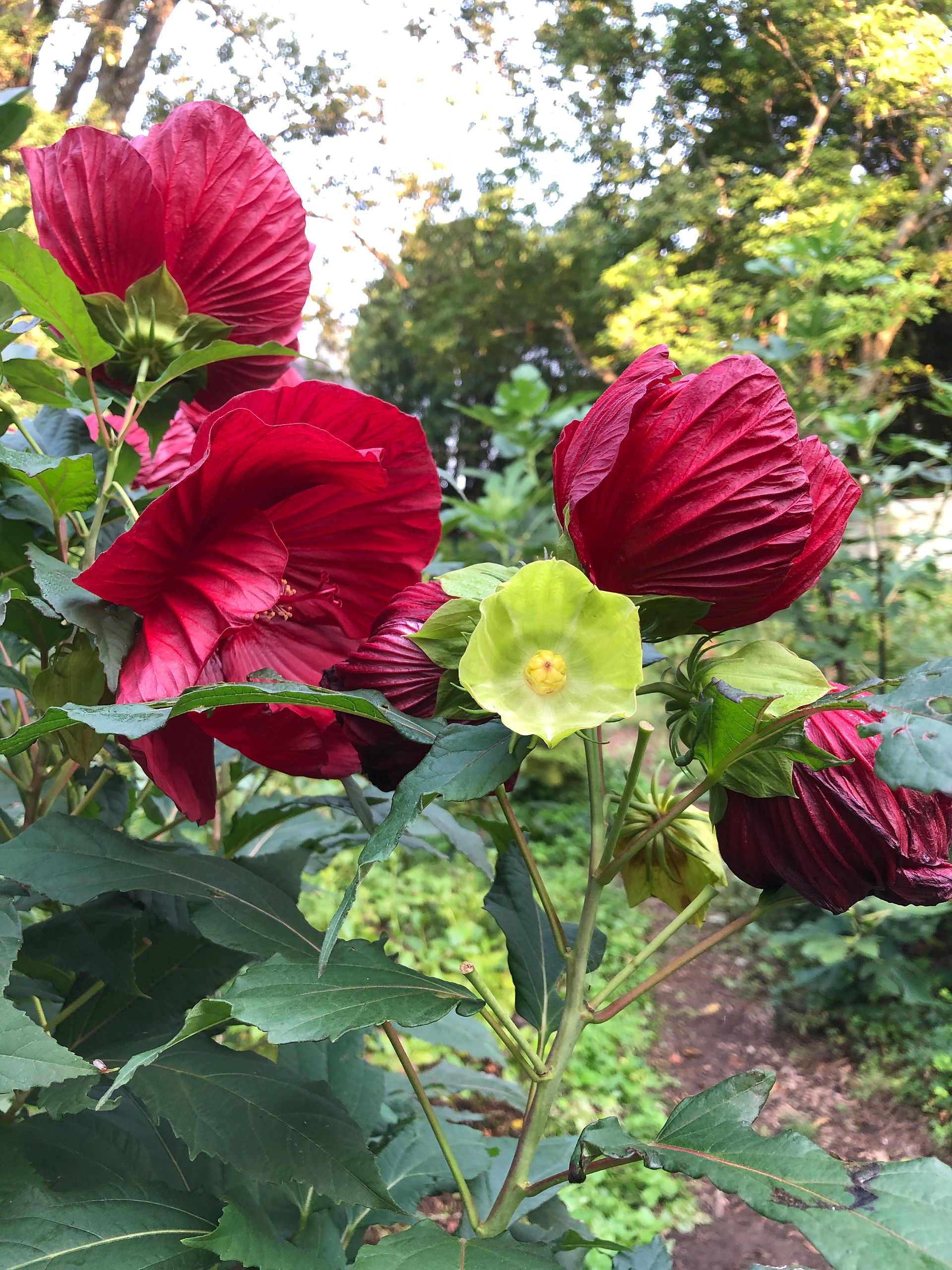
scarlet rose mallow 
cardinal flower
To add reds to the mix, grow cardinal flower (Lobelia cardinalis) in wetter areas and scarlet rose mallow (Hibiscus coccineus), native to the southeast, in wet to average soils. Both add striking red flowers in late summer and early fall. Neither like dry soils or drought.

turtlehead 
mountain mint 
penstemon
To add white, penstemon (Penstemon digitalis), mountain mint (Pycanthemum muticum) and turtlehead (Chelone glabra) are all long blooming and easy to grow. Penstemon blooms in early summer, has a long bloom time and self sows. Mountain mint has very subtle flowers but reads as white from a distance in the garden for most of the summer. It is also is a pollinator powerhouse. Turtlehead blooms in late summer and is the host plant for the Baltimore checkerspot butterfly so is another must for the Maryland State flag garden.

goldenrod 
bluestar hubricthii
For fall, growing goldenrod (Solidago canadensis) for the flowers and bluestar hubrichtii (Amsonia hubricthii) for the long lasting and striking bright gold foliage in fall will add that final touch of gold to your growing season. The straight species of goldenrod shown here is very aggressive and not suited to smaller garden situations. Showy goldenrod (Solidago speciosa) and fireworks goldenrod (Solidago rugosa 'Fireworks') are commonly available alternatives that are not aggressive and are adaptable to a variety of conditions.
Shade
Shade comes in gradations. Full shade is anything less than four hours of sun a day. Part shade areas get four to six hours of sun a day. That may seem like a lot of sun but, alas, it is only enough to qualify as part shade. There is also dappled shade -- no direct sun but light filtering through the canopies of trees for most of the day. These plants should do well in all of the shades.
Dogwood

dogwood flowers in spring 
dogwood foliage in fall
For shade, the obvious tree choice is the iconic flowering dogwood tree (Benthamidia florida). The enchanting white spring flowers will kick off your Maryland State flag garden in good classic form.
Possumhaw Viburnum

possumhaw flower in spring 
possumhaw foliage in fall
For shade, possumhaw viburnum (Viburnum nudum) shrub has white flowers in early summer. The real reason to add this shrub to your Maryland flag garden is its bright red foliage in fall. Simply stunning. This large shrub grows in sun and part shade and needs some moisture. It ideally grows in moist acidic soils but can be grown in other soils so long as it is not allowed to dry out.
Wild Hydrangea

You can also add wild hydrangeas (Hydrangea arborescens) for their very long lasting white blooms in summer. Perfect also for cutting. It thrives in shade. While it can be grown in sunnier spots, in those locations the shrub will need regular moisture.
Perennial Flowers

foamflower at Mt. Cuba 
wild columbine 
green and gold
For early spring, foamflower (Tiarella cordifolia) is a low growing plant, perfect for planting beneath the canopies of trees and for moister woodsy type of spots. Wild columbine (Aquilegia canadensis) blooms in spring and if you let the seed heads turn brown and don't mulch, it will disperse seeds which will germinate the following year. If you do this, your columbine will tell you where it best grows by self-sowing in that area. Green and gold (Chrysogonum virginianum) is another low growing ground cover for shady areas that blooms with gold flowers in spring.

golden ragwort in spring 
golden ragwort in fall
Golden ragwort (Packera aurea), a reliable and fast spreading perennial, particularly in moist areas, has long lasting gold daisy like flowers in spring and early summer. The foliage is dark green and makes a great ground cover. This plant is evergreen in many areas.

Indian pinks (Spigelia marilandica) are the perfect perennial flower for summer in shade. They are long blooming once established and add pops of red and yellow to your shady spots. In my garden, they flush with flowers in early summer but then periodically re-bloom. They grow in full sun to part shade.

For late summer and fall, add heuchera 'Autumn Bride' (Heuchera villosa "Autumn Bride') to your shady areas to ensure a long late summer and fall season of white flowers. So easy to grow and they add so much to any garden in late summer when many flowers are past peak.
Winter Interest

winterberry early fall 
red twig dogwood 
American holly
We can't forget winter! Red twig dogwoods (Cornus sericea) with dark red stems add lots of interest in winter, particularly if planted in front of an evergreen. Winterberry shrubs (Ilex verticillata) and American holly trees (Ilex opaca) will make birds happy by providing red berries for food over the winter months. All of these are fairly adaptable and easy to grow.
Please note winterberry shrubs are either female or male. The female shrub produces the berries. To get the berries, you must plant a female shrub and a male shrub. The male shrubs are smaller and can easily be tucked anywhere within about 50 feet of the female shrub. This may sound complicated but places that sell winterberries almost always carry the females and the males. Plant these shrubs just like you would a tree.
The Maryland State Flag
Initially recreating the colors of the Maryland State flag in a garden seemed like a very narrow palette. When you look at all of these great choices, though, it seems like it will work fabulously. Which plants would you add to the list?
The current design of the State flag has flown in Maryland since the late 1800s and was officially adopted in the very early 1900s. Those native plants have been around a whole lot longer. We need to let them fly!
Happy Gardening.


That fringe tree is very handsome, and I remember a gardener telling me it often sends out suckers and self-seeds, giving her young plants to share with others, which is great, since it’s not a tree I see in nurseries very often!