


Gardens of Buffalo: A Thriving Garden Culture, Generosity, Inspiration & Native Plant Garden Ideas!
Updated: Jul 17
Buffalo Garden Walk, Open Gardens & More.

Each summer, a group of garden writers, videographers, photographers and other content creators gather in a different location, just to visit gardens! So much fun. This years Garden Fling happened in Buffalo, New York. Situated along the waterfront of Lake Erie, I was heartened to learn Buffalo is so much more than steel production sites, football, ice hockey, chicken wings and snow. No shade on those but Buffalo has a lot going on!

Buffalo offers a panoply of choices for gardeners. There is the Garden Art Sale held annually in late June. In July, dozens of private gardens are open to the public on Thursdays and Fridays. Known as Open Gardens WNY, you purchase your guide for $20 and that gives you entree and all the info you need to visit ninety gardens! And the crown jewel of the summer is Garden Walk Buffalo, a celebration hosted by homewoners across the City of Buffalo who open their gardens at no charge to thousands of visitors. This year's Garden Walk is on July 25th and 26th.
Connections between mid-Atlantic and western New York gardens? In the mid-Atlantic our gardens range from USDA growing zone 8a in southern Virgninia and the lower shore, to zone 7 in Washington and Baltimore to zone 6 with a few pockets of zone 5s in Pennsylvania. Buffalo is squarely in zone 6b. Annual rainfall in Buffalo and Baltimore is comparable at around 40" per year.

One big difference is in our ecoregions. These regions, designated by EPA, are areas where ecosystems are generally similar. Here, in the Chesapeake Bay watershed, our ecoregions inlcude the middle Atlantic Coastal Plain, the southeastern plains, the northern piedmont, the piedmont and the blue ridge. Buffalo is in the eastern Great Lakes lowlands. The Buffalo area typically has rich loamy soil (and please note, this is a generalization!). Across the Chesapeake we have a mix of soils generally ranging from sandy loamy soils near the coasts to heavy clays in the piedmont area and acidic loamy soils to the west. Again, another generalization. So, all in all, these are definitely different areas though we have similarities too. And we do share some of the same native plants!
Mixing In Native Plants
Most of us inherit gardens filled with ornamental plants. One easy way to get started on your native plant garden is to begin adding native plants to the garden you already have. Trees and shrubs offer the most real estate to allow your insect and bird populations to grow. Perennials are important sources of nectar and many are also host plants - plants that a particular type of insect must have to reproduce. The Buffalo gardens I visited almost all had at least a couple of native plants and some had many more. There were many creative examples of how to mix natives with plants from afar.
Perennial Mixes

Jay Jinge Hu, who famously creates videos by asking people if he can see their gardens, generously opened his garden to us. In a sunny side border, Jay mixes straight species coneflowers (Echinacea purpurea) with his favorite coneflower cultivars (Echinacea) and a mass of black eyed susans (Rudbeckia), fully in bud and ready to pop. Truly beautiful. If you like to visit gardens, check out Jay's You Tube channel, Whispers in the Garden.
Bee Balm
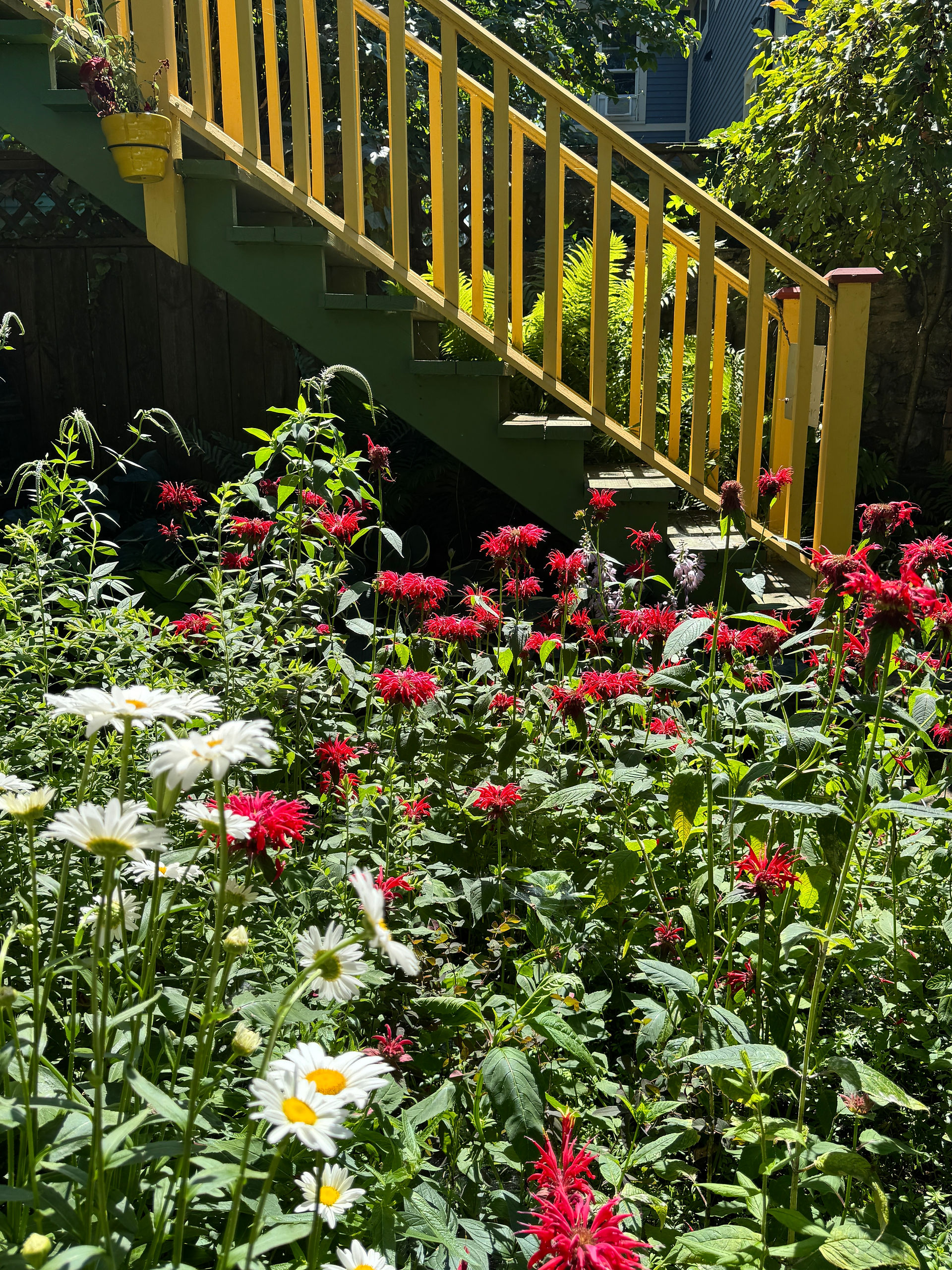
scarlet bee balm and daisies 
hummingbird moth 
scarlet bee balm and coneflowers
Scarlet bee balm (Monarda didyma) was in full bloom in mid-July in Buffalo, a little later than here in the middle of the Chesapeake watershed. So many Buffalo gardeners were growing this bee balm, typically mixed into perennial borders. The combination of scarlet bee balm and coneflowers was pretty inspired. I also made a mental note to try growing scarlet bee balm again after I saw hummingbird moths getting nectar from it. So cool. Scarlet bee balm needs sun and moist soils to thrive.
Elderberry
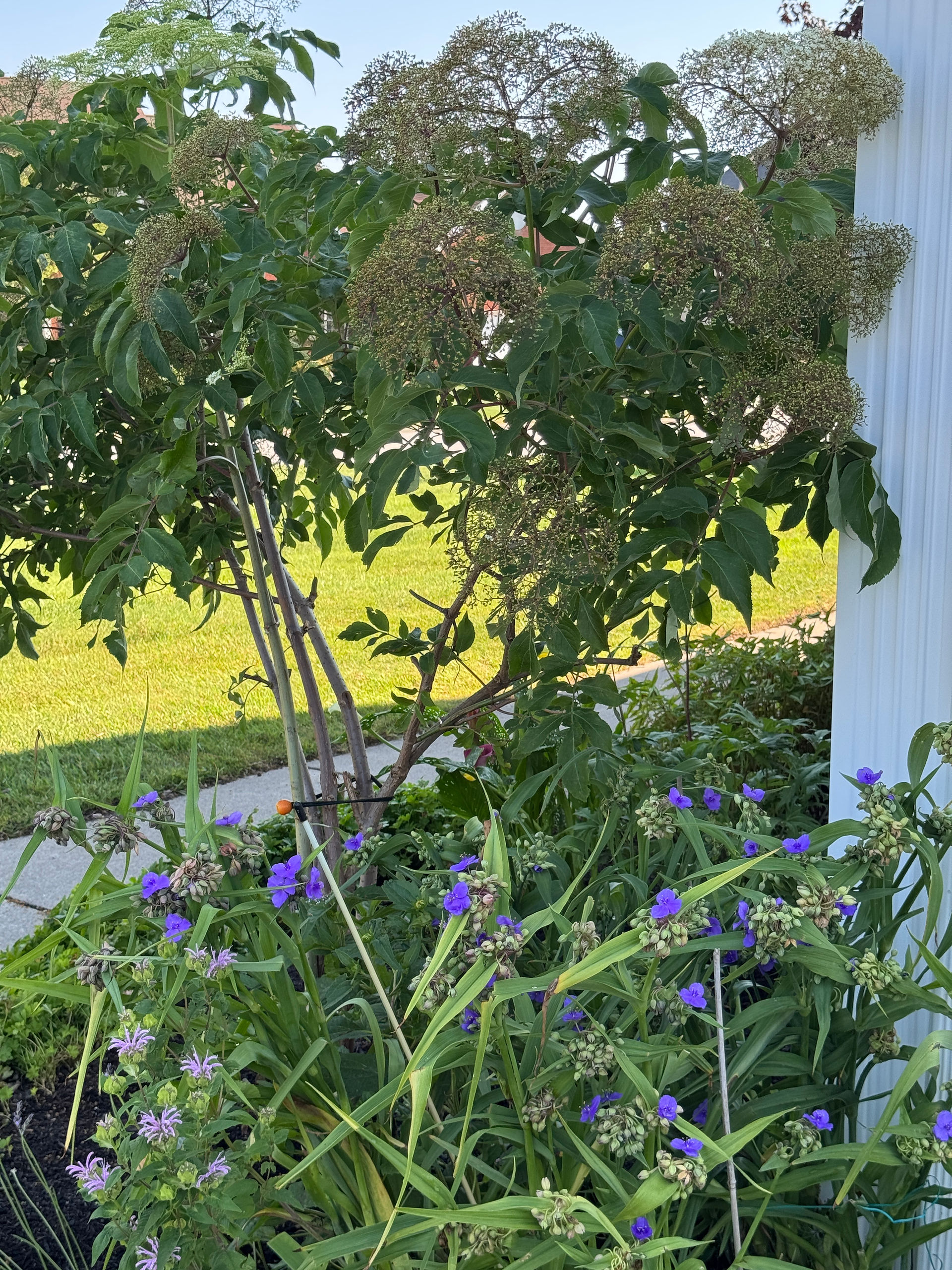
elderberry and spiderwort 
elderberry flower buds 
elderberry crop
Elderberry (Sambuca canadensis) is a large suckering shrub with huge white flowers and is a magnet for pollinators and birds. There are all sorts of uses for the berries. Because of the size, edlerberry can be hard to place in smaller residential gardens. At the left, elderberry is pruned as a small tree at the corner of the foundation plantings of a home. If you are able to prune at least a couple of times a growing season, this can be a good way to grow it. On the right, elderberry is grown as a crop for the berries. The shrubs are surrounded by t-posts and heavy duty twine to keep them in a tight formation. This makes it easier to protect the fruit from birds since these are grown specifically to harvest berries. The best location for elderberry shrubs is at the back of a deep border, as part of a hedgerow or as a stand alone tree sized shrub. If you can fit it in, it's such a huge plus for wildlife!
Winterberry

winterberry in garden bed 
winterberry growing as a crop
Winterberries (Ilex verticillata) grow well as part of a border, coming to the fore when they form bright red berries in fall . Winterberries thrive in moist soils and grow just fine in average moisture soils. In the wild, they spread by suckering. Pruning off the lower growth and shaping the winterberries into small trees, like this, is a way to manage the suckering and also to allow underplanting. This is a great technique for a neater style garden.
These suburban farmers grow an amazing diversity of crops and plants. Wendy and Jeff Leyonmark also grow winterberry, red twig dogwood and a cultivar, yellow twig dogwood (Cornus sericea and Cornus sericea 'flaviramea') as crops for harvesting branches for seasonal decoration in winter.
If you are new to growing winterberry, please note berries form on female plants. To grow plants that set fruit, you also need one male plant. Typically, these are sold side by side in garden centers and native plant nurseries.
Solomon's Seal

The gardener at this home told me these are the straight species of solomon's seal (Polygonatum biflorum). You probably know solomon's seal is always described by experts as a shade plant. I was so surprised to see it growing in full sun. The gardener told me there had been a large tree along this fence when the solomon's seal was planted and she fully expected it to wane in the newly sunny area. A couple of years in though, it is still growing strong. I include this only to observe that we often think of plants and the information on plant tags as products when this shows, they are unique and living. You just never know!
Spiderwort

Particualrly true if you prefer a neater or tidier garden, spiderwort can be challenging becuase of its strappy foliage. In many Buffalo gardens, a small clump was nesteld among other perennials. This seems like a good placement. Also, culitvars like 'Sweet Kate' (Tradescantia (Andersonia group) 'Sweet Kate') are more compact and neater. More about growing spiderworts here.
Ferns

This garden bed is one of many at Murray's Hosta Farm. All of the beds were filled to the brim with ... hostas. Hundreds and hundres of varieties of hostas. This bed is also somewhat of a master class in layering trees, shrubs and perennials. This layering design, having the three heigths of plants, is ideal for birds. The more native plants in those layers, the better!

sensitive ferns among hostas 
ostrich ferns among hostas
Native ferns, mostly sensitive ferns (Onoclea sensibilis) and ostrich ferns (Onoclea struthiopteris), were used in drifts to contrast with all of those hostas. This is a little bit of a clue for the right plant, right place mantra. If you can grow hostas in your garden, you likely can also grow sensitive ferns and ostrich ferns, both of which need moist soils to thrive.
Paw Paws

paw paw fruit 
paw paw trees
In this garden of meandering walkways, a path of grass wound right between two fruiting paw paws (Asimona triloba). The paw paws were adjacent to several ornamental evergreens and the contrast really set the paw paws off to advantage. And those fruits - beautiful! These are good garden trees as they grow 15 to 30 feet tall depending on their situation so on the smaller side.
Bottlebrush Buckeye

Bottlebrush buckeye (Aesculus parviflora) is a very large shrub or small tree. It grows to 12 feet wide and does best in shade or part shade. Since it is so wide, it can be challenging to think of how to use it in a garden. I thought this placement, beneath a very old, mature crab apple tree, was a perfect example of graceful layering of shrubs.
River Birches Compared

mature river birch straight species mature river birch 'Little King' FOX VALLEY
At Draves Arboretum, outside of Buffalo, the two most commonly available river birches are planted side by side. Both of these tree are 45 years old. On the left, is the straight species river birch (Betula nigra). On the right is the smaller cultivar known as river birch 'Little King' FOX VALLEY (Betula nigra 'Little King' FOX VALLEY). This cultivar is often sold at garden centers with large selections of trees like Merrifield Garden Center in Falls Church. I had always wondered what it would eventually look like. Thomas Draves did mention how often he sees the straight species of river birch planted within ten feet of a home. That's never going to last too long. Good advice!
Just Plain Inspired!
Kreutzer Garden 
Jay's Garden 
Charlier Garden 
Coyne DeNezza Garden 

Hopkins Dunlap Garden Leyonmark Suburban Farm 

Jay's Garden 
Leyonmark Suburban Farm 
Buscaglia Garden
The gardeners of Buffalo and their gardens burst at the seams with creativity and generosity. Intrigued? Well, it's not too late! The are still lots of opportunities to see Buffalo gardens this summer. Take in the Open Gardens on Thursdays and Fridays in July and/or stay for Garden Walk Buffalo on July 25th and 26th. Oh, and there is another event this year, Open Gardens Night Lights the evening of July 31st. It includes twenty-five gardens open in the evening. There is also a bus option. To sign up, you just need to purchase the Open Gardens WNY Garden Guide. Thank you Buffalo!
Happy Gardening.


Love reading your different focus - makes me look my Buffalo Fling garden photos in a new light.
Great information about the ecoregions, Shari! It's always fascinating to see how ecological systems wrap and shift and change--around the country and the world. That Solomon's Seal border surprised me, too. I've never planted any, but it's very prevalent and naturally occurring in our woodland. I really liked that unexpected grouping of it along the fence.
Great post! I am very skeptical that the solomans seal would perform the same here in MD.
It's wonderful to see such beautiful gardens. I'm impressed with how great they look with the much shorter growing season up there. Maybe all those plants like the heavy snow cover?
I'd like to put in a good word for elderberry. It's fast growing and fantastic for wildlife--pollinators and birds adore the shrub. I limbed mine up to look like a multi-stemmed tree, which made it easy for me to spot suckers when they were tiny and very easy to pull. The flowers smell like anise and the berries make a delicious syrup (doesn't taste anything like anise), which I used every summer to make a refreshing cold drink. I made a deal with the mockingbirds--I'd harvest the berries I…
The design elements are so useful to look at. Thank you for sharing these. My bottlebrush in super dense shade are finally blooming. I think it's all the rain we got this year.